Why X‑Rays Alone Don’t Tell the Whole Story
Plain radiographs are excellent for visualizing bone alignment, fractures, and gross degenerative changes, but they provide only a static, two‑dimensional view of dense structures. They cannot detect soft‑tissue injuries, early disc degeneration, nerve irritation, muscular tension, or functional abnormalities that often underlie musculoskeletal pain. Consequently, relying solely on X‑rays may miss the biomechanical contributors to a patient’s symptoms.
A thorough clinical examination—comprising a detailed history, palpation, range‑of‑motion testing, orthopedic special tests, and neurological assessment—captures the functional and neuromuscular aspects that X‑rays overlook. Motion palpation reveals joint restrictions and tissue texture changes in real time, while posture analysis, gait screening, and functional movement tests identify compensatory patterns and alignment issues invisible on static films.
Radiation‑free diagnostics complement the exam and reduce unnecessary exposure. Surface electromyography (sEMG) quantifies abnormal muscle activation, thermography highlights inflammation through skin‑temperature maps, and musculoskeletal ultrasound provides real‑time images of tendons, ligaments, and discs without ionizing radiation. Digital posture analysis and motion‑capture systems further objectify spinal alignment and segmental mobility, offering a comprehensive, low‑risk picture of spinal health that guides personalized, non‑invasive chiropractic care.
Understanding Chronic Musculoskeletal Pain
Key Points
| Aspect | Details |
|---|---|
| Typical Symptoms | Persistent dull ache, throbbing, stiffness (especially morning), fatigue, sleep disruption, tingling/numbness |
| Common Causes | Unresolved injuries, osteoarthritis, disc degeneration, rheumatoid arthritis, repetitive strain, poor ergonomics, obesity, systemic inflammation (fibromyalgia) |
| Impact | Reduced mobility, altered posture, off‑balance feeling, decreased quality of life |
 Chronic musculoskeletal pain is persistent or recurrent pain that originates from muscles, bones, joints, ligaments, or tendons and lasts for three months or longer. It often develops when an acute injury or overuse does not heal fully, or it can stem from degenerative conditions such as arthritis, disc disease, or fibromyalgia. The pain may be dull, achy, sharp, or throbbing and can limit mobility, cause stiffness, fatigue, and disrupt sleep. Because it is multifactorial, chronic musculoskeletal pain frequently requires a multimodal treatment approach that combines physical therapy, spinal adjustments, targeted exercises, and education to restore function and improve quality of life.
Typical symptoms include a persistent, dull ache or throbbing sensation in the muscles, joints, or bones that lasts for weeks or months. Stiffness, especially after inactivity or in the morning, limits range of motion and makes everyday tasks difficult. Fatigue, disrupted sleep, and occasional tingling or numbness in the extremities are common, reflecting nerve irritation. Overall, the pain can lead to reduced mobility, altered posture, and a sense of being “off‑balance.”
Underlying causes often involve injuries that never fully heal—unresolved sprains, strains, or fractures that cause ongoing inflammation. Degenerative conditions such as osteoarthritis, disc degeneration, and rheumatoid arthritis gradually wear down joints, ligaments, and discs. Repetitive‑strain activities, poor ergonomics, prolonged static postures, obesity, age‑related wear‑and‑tear, and systemic inflammatory diseases (e.g., fibromyalgia) also contribute. Frequently, a combination of mechanical, degenerative, and systemic factors interact, making the pain chronic rather than acute.
Managing Pain Without Drugs
Non‑Drug Management Overview
| Modality | Goal | Example Techniques |
|---|---|---|
| Chiropractic Adjustments | Restore joint mobility, reduce nerve irritation | Spinal adjustments, motion palpation |
| Myofascial Release | Relieve muscle tension | Soft‑tissue release, trigger point therapy |
| Spinal Decompression | Improve disc health | Mechanical traction devices |
| Cold Laser Therapy | Reduce inflammation | Low‑level laser application |
| Therapeutic Orthotics | Correct alignment | Custom shoe inserts |
| Corrective Exercise | Build strength & posture | Targeted core, flexibility programs |
| Ergonomic Education | Prevent recurrence | Workplace and daily activity advice |
| Lifestyle Modifications | Support overall health | Weight management, sleep hygiene |
| Functional Assessment | Guide treatment | Range‑of‑motion testing, EMG, thermography |
 Chronic musculoskeletal pain is often initially treated with NSAIDs such as ibuprofen or naproxen, acetaminophen, muscle relaxants, and, in select short‑term cases, low‑dose opioids. Antidepressants and anticonvulsants may be added for neuropathic components, but these drugs address symptoms rather than the underlying biomechanical cause and carry risks of side‑effects and dependence.
At a chiropractic practice, care shifts to a multimodal, non‑invasive protocol. A thorough patient history and physical exam guide patient‑specific spinal adjustments, motion palpation, and myofascial release to restore joint mobility and reduce nerve irritation. Adjunctive therapies—spinal decompression, cold laser, therapeutic orthotics—target disc health and alignment. Structured corrective‑exercise programs and ergonomic education empower patients to maintain posture, improve function, and prevent recurrence without medication or surgery.
While chronic pain alone is not automatically a disability, severe, function‑limiting pain can meet Social Security Administration criteria for disability benefits when it markedly impairs work and daily activities. Documentation by a qualified clinician, functional assessments, and a minimum 12‑month duration are required for eligibility.
Thus, integrating evidence‑based chiropractic care with careful medication use offers a drug‑free pathway to pain relief and functional recovery, while also addressing potential disability considerations.
When Doctors Talk X‑Rays and Chiropractic Care
Physician Perspective & Imaging Decision‑Making
| Topic | Summary |
|---|---|
| Doctor View of Chiropractors | Generally supportive for spine/joint injuries; see chiropractors as safe, evidence‑based partners; some caution due to limited familiarity |
| Reason to Avoid X‑rays | Ionizing radiation risk (cancer, cataracts, fetal harm); guidelines demand justification; unnecessary imaging can cause incidental findings and extra cost |
| Patient Right to Decline | Informed consent required; clinicians must explain implications, offer alternatives, and document refusal |
| Alternatives to X‑ray | Physical exam, ultrasound, MRI, thermography, functional screening |
 What do medical doctors think of chiropractors?
Most physicians view chiropractors as valuable partners for spine‑ and joint‑related injuries, especially whiplash, muscle strain, and limited mobility that respond well to non‑surgical, hands‑on care. Many appreciate chiropractic as a safe, evidence‑based option that can reduce pain and improve alignment while they handle imaging, medication, or surgery. Some clinicians remain cautious due to limited familiarity with chiropractic training and lingering stereotypes, but the opioid crisis has spurred referrals to chiropractors as part of multidisciplinary, drug‑free pain‑management plans. The trend is toward collaborative care rather than competition.
Why do some doctors avoid ordering X‑rays?
Ionizing radiation from X‑rays raises lifetime cancer risk and can cause cataracts or fetal harm. Guidelines stress justification—imaging only when benefits outweigh risks. For many musculoskeletal complaints, a thorough physical exam and low‑dose modalities (e.g., ultrasound) provide sufficient information. Unnecessary X‑rays can generate incidental findings that lead to costly, invasive testing. Clinicians therefore prioritize minimizing radiation while still achieving accurate diagnoses.
Can a patient decline X‑ray imaging?
Yes. Patients have the right to refuse any diagnostic procedure. Clinicians should explain the impact of refusal, offer alternatives, and document the decision. Concerns about radiation exposure, pregnancy, or personal beliefs should be addressed with clear information about low doses and safety measures. Ultimately, informed patients make the final choice.
Radiation‑Free Alternatives for Sensitive Populations
Imaging Options & Radiation Dose
| Modality | Radiation Exposure | Typical Use |
|---|---|---|
| Ultrasound (including Doppler) | None (sound waves) | Muscles, tendons, ligaments, fluid collections |
| MRI (no gadolinium) | None (magnetic fields) | Spinal discs, nerves, soft‑tissue detail |
| Digital Infrared Thermography | None (infrared light) | Inflammation mapping, blood‑flow assessment |
| Surface EMG | None (electrical activity) | Muscle activation patterns |
| Limited‑field MRI | None | Bone detail when X‑ray avoided |
| Plain X‑ray | ~0.1 mSv (≈10 days background) | Basic bone alignment |
| CT Scan | 1‑8 mSv (10‑80× X‑ray) | Detailed cross‑sectional anatomy |
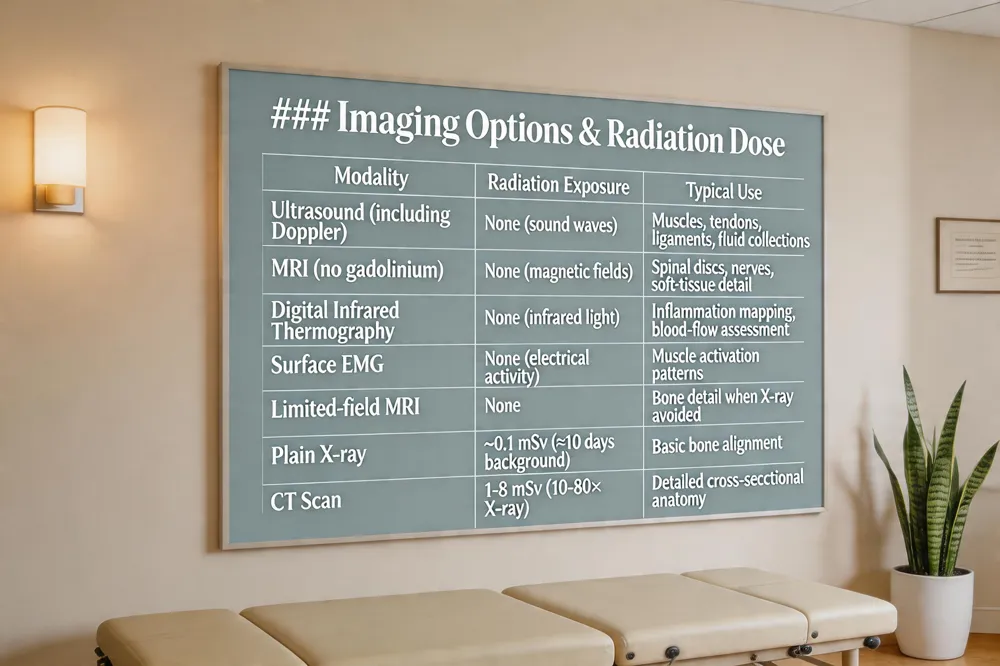 Pregnant patients should avoid ionizing radiation, so clinicians turn to ultrasound—including Doppler studies—and magnetic resonance imaging (MRI) without gadolinium contrast. Ultrasound offers real‑time, radiation‑free visualization of muscles, tendons, ligaments and fluid collections, while MRI provides high‑resolution images of spinal discs, nerves and soft tissues without any radiation exposure. When bone detail is required, limited‑field MRI or specialized musculoskeletal ultrasound can be used in place of an X‑ray, protecting the developing fetus.
Beyond pregnancy, a range of non‑radiation diagnostics are available. MRI and diagnostic use magnetic fields and high‑frequency sound waves, respectively, to image bone, joints and soft tissues without ionizing radiation. Digital infrared thermography maps skin temperature patterns, highlighting inflammation or altered blood flow without any exposure. Functional movement screening, thorough clinical examinations, and tools such as surface electromyography (sEMG) and posture analysis provide valuable biomechanical information without imaging at all.
Radiation dose differs dramatically between modalities. A plain X‑ray delivers about 0.1 mSv—equivalent to ten days of natural background radiation—whereas a CT scan can range from 1 mSv (head) to 7–8 mSv (abdomen‑pelvis), representing 10‑to‑80‑fold higher exposure. Consequently, CT scans are more harmful than single X‑rays, and both are outweighed by radiation‑free alternatives whenever clinically appropriate.
A Practical Spinal Health Check‑Up
Typical Chiropractic Spinal Assessment Steps
| Step | What Is Done |
|---|---|
| History Intake | Review medical history, symptoms, lifestyle |
| Posture Analysis | Visual assessment of standing/sitting alignment |
| Range‑of‑Motion Testing | Evaluate flexibility and movement limits |
| Orthopedic/Neurological Maneuvers | Identify specific joint or nerve involvement |
| Motion Palpation | Feel joint motion quality |
| Surface EMG / Thermography | Detect muscle tension, inflammation |
| Functional Screening | Movement patterns, core stability tests |
| Treatment Planning | Personalized adjustments, exercises, ergonomic advice |
| Imaging Decision | Use low‑dose digital X‑ray only if red‑flag signs or structural concerns exist |
 How can I tell if my spine is healthy?
A healthy spine feels free of persistent pain, stiffness, or tension in the back, neck, or shoulders. You can bend, twist, and lift without discomfort, enjoy normal posture while sitting and standing, and sleep through the night without waking from back or neck pain. Absence of frequent headaches, chronic fatigue, or unexplained numbness in the arms or legs suggests no nerve irritation. Strong core stability and a full, pain‑free range of motion are positive signs; recurring joint pain, muscle spasms, or loss of mobility should prompt a professional evaluation.
What can I expect during a spinal assessment at a chiropractic clinic?
The visit begins with a thorough health history, followed by posture analysis, range‑of‑motion testing, and orthopedic and neurological maneuvers. Chiropractors may use motion palpation, surface EMG, or thermography to detect joint restrictions, muscle tension, and nerve involvement. Findings guide personalized, non‑invasive treatment plans and determine if imaging is necessary.
Digital X‑ray advancements and safety
Modern low‑dose digital radiography provides clear bone images while exposing patients to far less ionizing radiation—often comparable to a few days of natural background radiation. Lead aprons, ALARA principles, and digital filters further minimize risk, making X‑rays a safe, selective tool when red‑flag symptoms or structural concerns arise.
Putting It All Together: A Safer, Smarter Way to Diagnose Pain
Chiropractors begin every encounter with a history and hands‑on assessment—palpation, range‑of‑motion testing, orthopedic special tests, and functional movement screens. These clinical skills reveal joint restrictions, muscle imbalances, and nerve irritation long before any radiograph is considered. When red‑flag signs (trauma, progressive neurologic deficit, suspicion of fracture) appear, or when structural alignment will be confirmed for a targeted adjustment, a low‑dose digital X‑ray is ordered. The image is then interpreted alongside the physical findings, allowing the practitioner to verify vertebral positioning, identify subtle subluxations, and monitor progress while adhering to ALARA principles.
Patient education is woven into each step. Clinicians explain why imaging is reserved for specific indications, describe the minimal radiation dose compared with natural background exposure, and use visual aids—posture maps, thermography heat maps, or sEMG graphs—to illustrate the underlying dysfunction. Informed patients are more likely to adhere to corrective exercises, ergonomic advice, and follow‑up schedules.
Looking ahead, radiation‑free modalities are reshaping diagnostics. Ultrasound, infrared thermography, surface electromyography, and emerging terahertz imaging provide soft‑tissue insight without ionizing exposure. As digital posture analysis and motion‑capture systems become mainstream, chiropractors will rely increasingly on functional data, reserving X‑rays for cases where bone pathology is truly suspected, thereby delivering safer, smarter care.