Introduction
Spinal decompression therapy is a non‑surgical, motor‑assisted treatment that gently stretches the spine using a computer‑controlled traction table. By creating a negative pressure within the intervertebral disc, the therapy encourages re‑hydration, reduces inflammation, and can draw herniated or bulging disc material back toward its proper position, relieving pressure on spinal nerves. Patients often turn to this approach when chronic neck, back, or leg pain persists despite medication, physical therapy, or rest. The appeal lies in its drug‑free, minimally invasive nature, which offers a safe alternative to surgery while still addressing the root cause of disc compression. Many individuals seek spinal decompression to avoid the risks, recovery time, and potential complications of operative procedures, hoping for pain reduction, improved mobility, and a quicker return to daily activities without relying on prescription drugs.
The First Visit: Evaluation, Cost and Insurance
| Item | Details |
|---|---|
| Session length | 30‑45 min |
| Cost per session | $75 – $125 |
| Typical series (12‑20 sessions) | $1,000 – $5,000 (package discounts/financing often available) |
| Insurance | Most plans label it experimental → no coverage. Some PPOs/ high‑tier plans may reimburse under broader CPT codes (97012, 98940‑98942) if medically necessary. |
| Patient action | Verify benefits, budget for out‑of‑pocket costs, discuss flexible‑spending‑account options with Ross Chiropractic. |
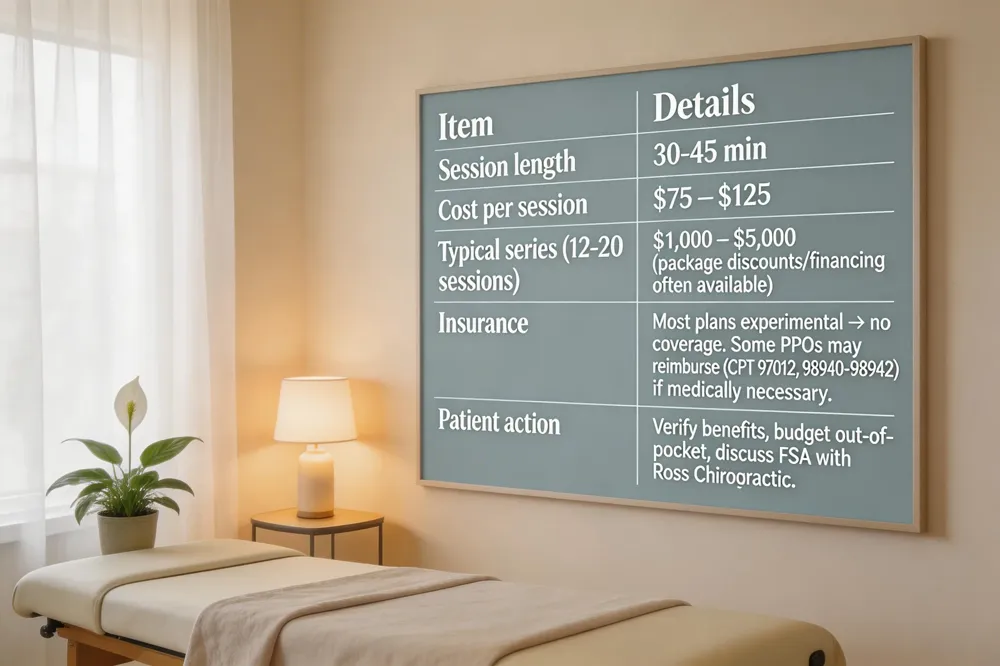 Spinal decompression therapy costs typically range from $75 to $125 per 30‑45‑minute session. A full series of 12‑20 sessions therefore totals $1,000‑$5,000, with many clinics offering package discounts or financing plans. At Ross Chiropractic we tailor pricing packages and can discuss flexible‑spending‑account options.
Insurance coverage is variable. Most traditional health plans, including Medicare, label mechanical decompression experimental and deny reimbursement. Some insurers will cover the treatment when billed under broader CPT codes (e.g., 97012, 98940‑98942) if deemed medically necessary, and PPOs or high‑tier plans may offer partial payment. Patients should verify benefits with their carrier and be prepared for out‑of‑pocket costs for the majority of the program.
Overall, the first visit establishes diagnosis, rules out risks, and clarifies the financial pathway so patients can decide whether to proceed with this drug‑free, non‑surgical option.
During the Session: Sensations, Equipment and Real‑Time Monitoring
| Component | Description |
|---|---|
| Equipment | Motorized traction table (e.g., Triton DTS, DRX‑9000) with padded pelvic/trunk harness. |
| Cycle pattern | 15‑20 sec stretch → brief relaxation, repeated 5‑8 times per session. |
| Session duration | 20‑30 min |
| Sensation | Mild, painless pulling; patients may feel slight muscle stretch. |
| Monitoring | Real‑time sensors track muscle tension; chiropractor adjusts force for comfort and safety. |
| Outcome indicators | Decreasing pain, improved ROM, easier exercises, reduced medication use (verified in follow‑up). |
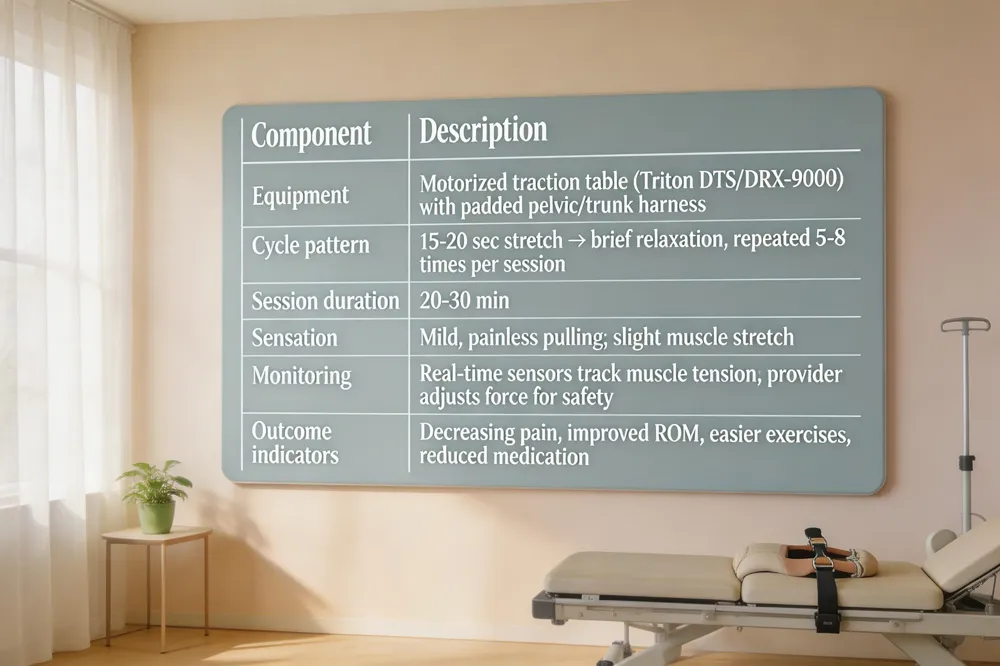 Spinal decompression therapy is performed on a motorized traction table—often the Triton DTS or DRX‑9000 system where a padded harness is secured around the pelvis and trunk. The computer‑controlled device applies a gentle pulling force that creates negative intradiscal pressure, allowing disc material to re‑hydrate and nerve roots to decompress. A typical session lasts 20‑30 minutes and follows a cycling pattern of incremental stretches (about 15‑20 seconds) followed by brief relaxation periods, repeating several times per visit.
Spinal decompression machine – The machine is a programmable, FDA‑cleared table that delivers precise traction forces based on the patient’s height, weight, and diagnosis, without any medication or surgery.
How to tell if spinal decompression is working? – Patients usually notice a gradual decline in pain intensity, improved range of motion, and easier performance of corrective exercises within the first few visits. Reduced reliance on pain‑relief medication and better posture are additional indicators of progress, confirmed by follow‑up assessments with Dr. Ross.
How long does it take to fully decompress the spine? – Significant relief often appears after 4‑6 sessions, while full therapeutic benefit typically manifests after 8‑12 appointments over four to six weeks. More stubborn cases may require 15 or more sessions, all customized to the individual’s condition.
During the treatment, sensors on the table monitor muscle tension in real time, allowing the chiropractor to adjust traction intensity for comfort and safety while the patient experiences a mild, painless pulling sensation.
Typical Treatment Timeline and Nerve Healing
| Phase | Frequency | Duration | Expected outcome |
|---|---|---|---|
| Core protocol | 2‑3 sessions/week | 4‑6 weeks (8‑12 sessions) | Noticeable pain relief in 4‑6 sessions. |
| Extended cases | Up to 20‑24 visits | 8‑12 weeks | Full therapeutic benefit for stubborn disc issues. |
| L5 nerve healing | Nerve regrowth ≈1 mm/day | 6‑12 months for full functional recovery (earlier improvements in weeks). | |
| Rehab support | Home exercises & lifestyle changes | Ongoing | Accelerates nerve healing and maintains results. |
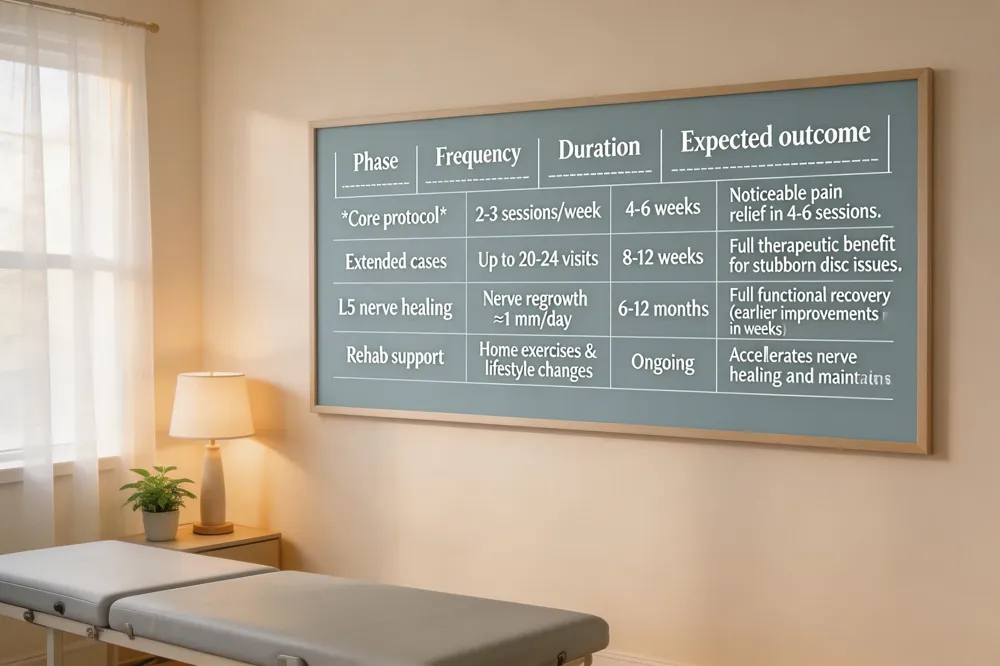 Spinal decompression programs generally consist of 8‑12 sessions spread over 4‑6 weeks, with most clinics scheduling 2‑3 treatments per week. Some patients may require up to 20‑24 visits for stubborn cases, but the core protocol aims to deliver measurable relief within the first 4‑6 sessions while supporting long‑term recovery.
How long does it take L5 nerve compression to heal after decompression? After a lumbar decompression for L5 nerve compression, most patients notice some relief within the first few weeks. Nerves regenerate at roughly one millimeter per day, so the healing process can extend over months. Full functional recovery typically takes six to twelve months, especially when the compression was long‑standing or severe. Younger, healthier individuals who follow post‑operative rehab and lifestyle guidelines may experience a faster timeline. While early improvements are encouraging, patience and a structured rehabilitation program are essential for the nerve to fully heal.
Spinal decompression exercises for sciatica Combine professional traction with targeted home drills: start each day with core‑stabilizing moves such as glute bridges and supine pelvic tilts, then perform knee‑to‑chest pulls, seated piriformis stretches, and cat‑cow mobilizations. Finish with a gentle child’s pose or cobra stretch to maintain disc hydration. Doing these exercises 2‑3 times weekly alongside clinic sessions accelerates pain relief, improves mobility, and helps prevent future flare‑ups without surgery or medication.
Home Care, Supplemental Exercises and Lifestyle Tips
| Exercise / Habit | Frequency | Duration / Reps | Goal |
|---|---|---|---|
| Bar‑hang | 3‑4 × week | 30 s – 2 min, 2‑3 sets | Gentle traction, vertebral separation. |
| Prone pillow stretch | Daily | 30‑60 s | Disc hydration, posterior chain stretch. |
| Cat‑Cow & Bird‑Dog | 2‑3 × week | 10‑15 reps each | Mobility, core stability. |
| Diaphragmatic breathing on foam roller | Daily | 5‑10 min | Relaxation, improves spinal alignment. |
| Sleep positioning | Every night | N/A | Neutral spine, reduced disc pressure. |
| Movements to avoid | Ongoing | N/A | Sit‑ups, heavy overhead presses, deep squats, high‑impact twisting. |
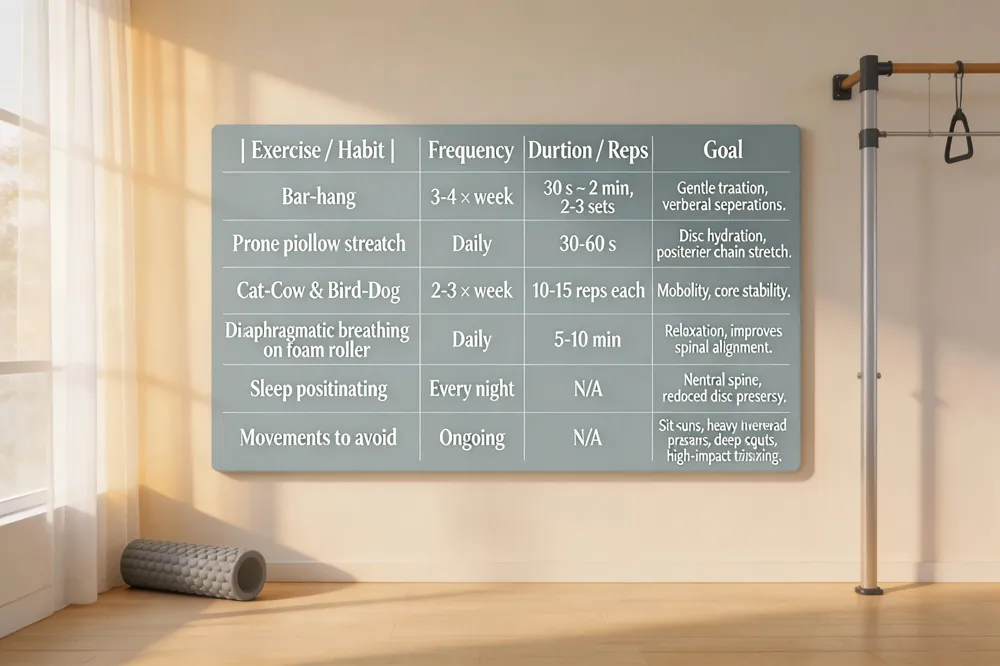 Gentle hanging for spinal traction: Find a sturdy pull‑up bar or overhead beam that can support your full body weight. Grip the bar shoulder‑width, engage your core, and let your body hang, allowing gravity to separate the vertebrae. Hold for 30 seconds to 2 minutes, rest, then repeat for 2–3 sets, 3–4 times weekly. Stop if sharp pain or dizziness occurs and consult a chiropractor first.
Everyday exercises that mimic decompression: Simple at‑home moves include the prone pillow stretch (face‑down with a pillow under the pelvis for 30‑60 seconds), side‑lying stretch off a couch edge, cat‑cow mobility drills, bird‑dog lifts, and diaphragmatic breathing on a foam roller. A brief bar‑hang (10‑30 seconds) adds a powerful traction effect. Perform these regularly to improve posture and spinal mobility.
Sleep positioning for nightly relief: Use a firm mattress and a pillow to keep the spine neutral. Place a pillow under the knees when lying on your back, or between the knees when on your side, creating a flexed‑hip posture that gently elongates the spine. Avoid stomach sleeping; if unavoidable, use a thin pillow under the abdomen. End the day with gentle stretches like child’s pose.
Movements to avoid during recovery: Skip exercises that load the spine with compression such as traditional sit‑ups, straight‑leg raises, heavy overhead presses, good mornings, deadlifts, and deep squats. High‑impact activities, rapid twisting, and prolonged slouched sitting also increase disc pressure and should be limited. Focus instead on core stabilization, myofascial release, and corrective exercises that support alignment without excessive loading.
Outcomes, Success Rates, Pros and Cons
| Metric | Details |
|---|---|
| Success rate | 70 %‑85 % (clinical studies) – up to 89 % in some case series; Mayo Clinic 88.9 % in 6‑week protocol. |
| Pros | Non‑invasive, drug‑free, customizable traction, avoids surgery. |
| Cons | Requires multiple sessions, limited long‑term data, insurance often unsupported, temporary soreness possible. |
| Contra‑indications | Osteoporosis, recent fractures, spinal implants, certain vascular conditions, severe infections. |
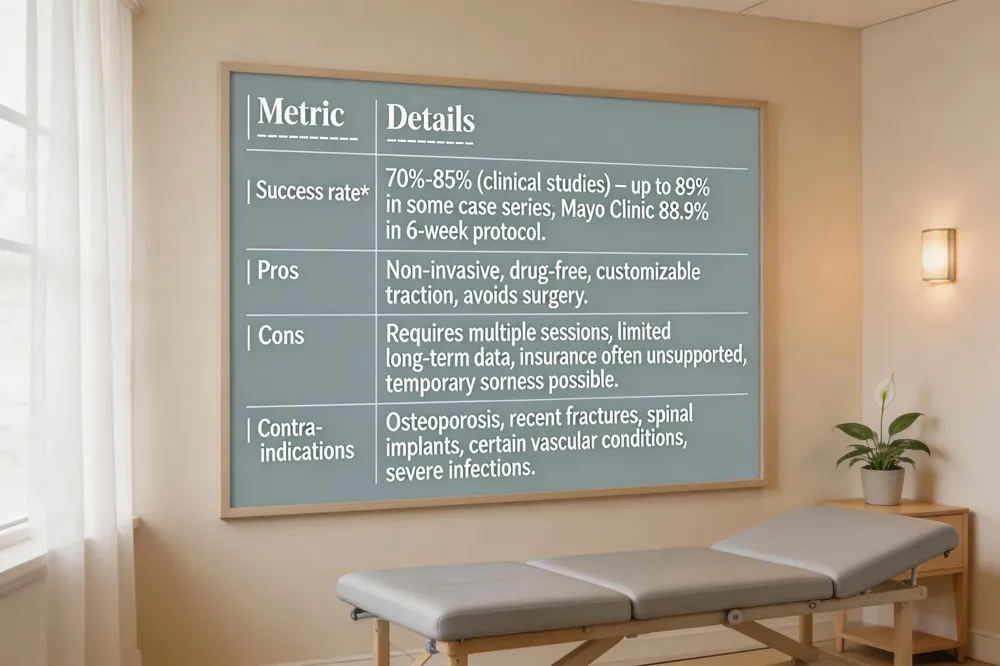 Clinical studies of non‑surgical spinal decompression report success rates ranging from roughly 70 % to 85 % for patients with disc‑related low‑back pain or sciatica, especially when combined with exercise and ergonomics education. Some case series show even higher improvements—71 % to 89 % of treated patients—and a Mayo Clinic six‑week protocol reported an 88.9 % success rate. However, the evidence base is limited, with only one small randomized trial and several lower‑level studies that have methodological concerns, so the high‑70s to low‑90s figures should be viewed as indicative rather than definitive.
Pros of spinal decompression include its non‑invasive, drug‑free nature, gentle traction that can relieve pressure on discs and nerves, and the ability to tailor the treatment to each patient, making it an attractive option for adults who wish to avoid surgery.
Cons and contraindications include the need for multiple sessions over several weeks before noticeable relief, limited long‑term efficacy data, and exclusions for patients with osteoporosis, recent fractures, spinal implants, certain vascular conditions, or severe infections. Insurance coverage can be inconsistent, and some individuals may experience temporary soreness or a brief increase in discomfort during or after treatment.
Personalized Care at Ross Chiropractic
| Service | Description |
|---|---|
| Assessment | Full spinal exam, imaging, lifestyle review. |
| Spinal decompression | Triton DTS system – computer‑controlled, real‑time muscle tension monitoring. |
| Adjunct modalities | Myofascial release, cold laser therapy, corrective exercises, custom orthotics. |
| Treatment plan | Tailored session frequency (2‑3 × week) + home program for optimal disc re‑hydration and posture. |
| Goal | Lasting pain relief, functional mobility, surgery‑free recovery. |
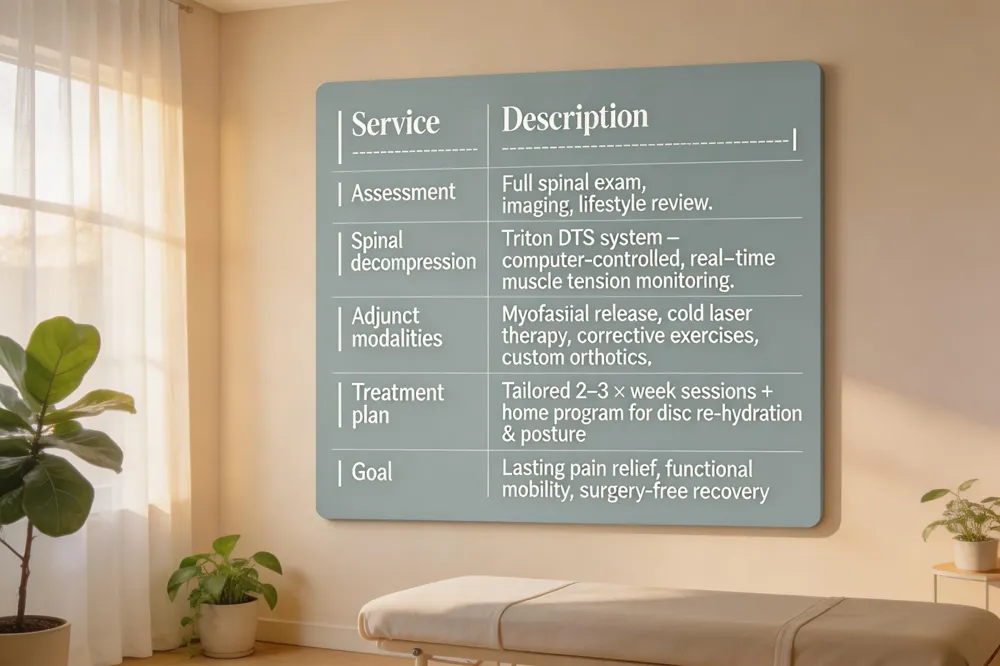 At Ross Chiropractic in San Jose, Dr. Allison Ross designs a holistic treatment plan that starts with a thorough assessment of each patient’s spinal condition, imaging findings, and lifestyle factors. After determining the appropriate frequency and duration of spinal decompression, the program is blended with adjunct modalities such as myofascial release, cold laser therapy, corrective exercises, and custom orthotics to enhance disc re‑hydration, reduce inflammation, and improve posture. The practice utilizes the industry‑leading Triton DTS system from Chattanooga, Inc., a computer‑controlled motorized traction table that delivers precise pull‑force, angle, and cycle adjustments in real time. This technology creates negative intradiscal pressure, encouraging the re‑positioning of herniated material while sensors continuously monitor muscle tension for safety and comfort. By combining personalized spinal decompression with supportive therapies, Ross Chiropractic aims to achieve lasting pain relief and functional mobility without surgery or medication.
Conclusion
Spinal decompression sessions are brief, non‑invasive appointments that use a motorized traction table to gently stretch the spine, create negative disc pressure, and promote re‑hydration of disc tissue. Most patients report a mild pulling sensation, little to no pain, and a feeling of lightness or increased mobility after each 30‑minute treatment. Clinical data show that more than 75 % of patients achieve meaningful pain reduction after completing a full series of 8‑12 (or up to 20) sessions, especially when the therapy is combined with adjunctive modalities such as myofascial release, cold laser, and corrective exercises.
Next steps for interested patients include scheduling a comprehensive evaluation to review history, imaging, and symptom profile; discussing individualized treatment frequency and duration; staying well‑hydrated and avoiding heavy lifting after sessions; and following prescribed home‑exercise and posture‑care plans to reinforce the benefits and support long‑term spinal health.