Why Your Feet Matter for a Pain‑Free Back
The body functions as a kinetic chain: the foot is the base that supports weight and initiates gait, so any abnormal foot mechanics travel upward, altering tibial rotation, hip alignment, pelvic tilt, and ultimately lumbar posture. Overpronation (flat feet) causes internal tibial rotation, an anterior pelvic tilt, and increased lumbar lordosis, while high arches or supination reduce shock absorption and force the spine to bear excess impact. Both patterns are linked to a higher incidence of chronic low‑back pain. Chiropractic care addresses these contributors by first evaluating foot posture through gait analysis and pressure mapping, then restoring proper alignment with foot joint adjustments, myofascial release of the plantar fascia and calf, and custom orthotics that support the medial arch. By correcting the distal source of mis‑alignment, the pelvis and lumbar spine return to a more neutral position, reducing muscle guarding and pain and supporting long‑term spinal health.
The Kinetic Chain: From Feet to Spine
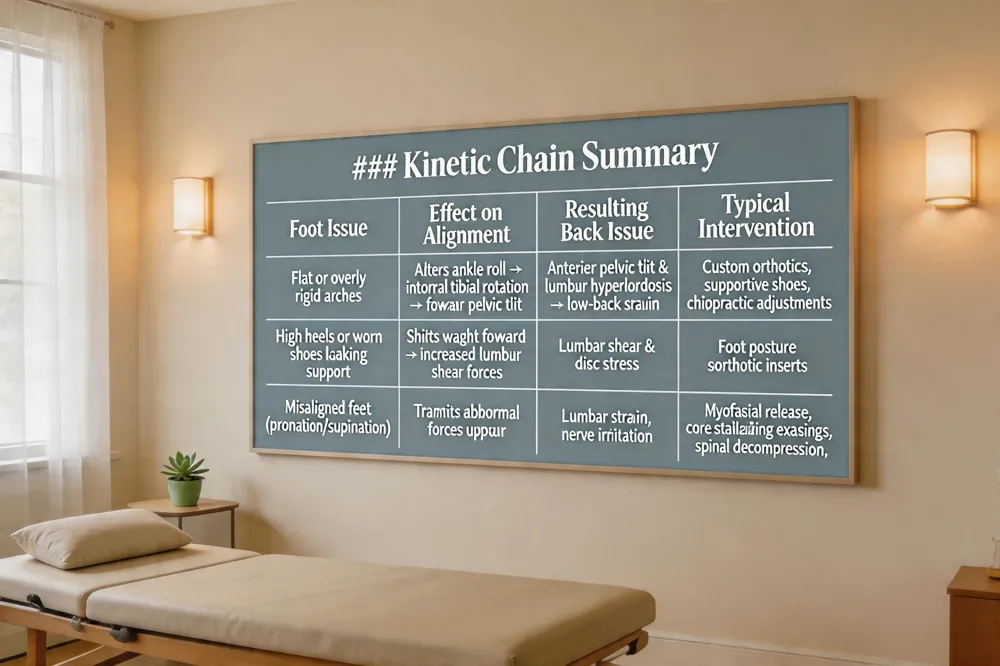
Kinetic Chain Summary
| Foot Issue | Effect on Alignment | Resulting Back Issue | Typical Intervention |
|---|---|---|---|
| Flat or overly rigid arches | Alters ankle roll → internal tibial rotation → forward pelvic tilt | Anterior pelvic tilt & lumbar hyperlordosis → low‑back strain | Custom orthotics, supportive shoes, chiropractic adjustments |
| High heels or worn shoes lacking support | Shifts weight forward → increased lumbar shear forces | Lumbar shear & disc stress | Foot posture supportive footwear, orthotic inserts |
| Misaligned feet (pronation/supination) | Transmits abnormal forces upward | Lumbar strain, nerve irritation | Myofascial release, core stabilizing exercises, spinal decompression |
 Can foot problems cause lower back pain?
Yes. Flat or overly rigid arches alter ankle roll, forcing the knees, hips and pelvis out of alignment. This creates anterior pelvic tilt and lumbar hyperlordosis, loading the lower back. Even footwear choices like high heels or worn shoes shift weight forward, increasing lumbar shear forces. Custom orthotics, supportive shoes and chiropractic care restore alignment and relieve the associated pain.
Can foot problems cause lower back pain?
Yes. Flat or overly rigid arches alter ankle roll, forcing the knees, hips and pelvis out of alignment. This creates anterior pelvic tilt and lumbar hyperlordosis, loading the lower back. Even footwear choices like high heels or worn shoes shift weight forward, increasing lumbar shear forces. Custom orthotics, supportive shoes and chiropractic care restore alignment and relieve the associated pain.
Flat feet and back pain Flat feet collapse the medial arch, causing overpronation, internal tibial rotation and a forward pelvic tilt. The lumbar spine compensates with increased lordosis, leading to chronic low‑back strain. Corrective orthotics and chiropractic adjustments, combined with myofascial release and core stabilizing exercises, break the compensation chain, improve posture and reduce pain without surgery or medication.
Back and foot pain related Misaligned feet transmit abnormal forces upward, provoking lumbar strain, while lumbar disc or nerve irritation can refer pain down the sciatic nerve to the foot. An integrated approach—spinal adjustments, spinal decompression, myofascial release, custom orthotics and corrective exercises—addresses both ends of the kinetic chain, restoring balance and providing long‑term, drug‑free relief.
Overpronation, Flat Feet, and Sciatica
Overpronation & Sciatica Table
| Condition | Biomechanical Impact | Sciatica‑Related Foot Symptoms | Recommended Treatment |
|---|---|---|---|
| Overpronation (flat shoes, lack of arch support) | Inward tibial rotation → forward pelvic tilt → increased lumbar lordosis | Tingling, burning, numbness on sole, toes, heel, outer edge | Custom orthotics, spinal decompression, myofascial release, corrective exercises |
| Collapsed arch (pes planus) | Alters gait, internal femoral rotation, pelvic tilt | Radiating pain down sciatic nerve | Endchanical spinal adjustments, targeted myofascial work, orthotic support |
| Lumbar disc degeneration with sciatic irritation | Lumbosacral nerve compression → referred foot pain | Burning, shooting pain in foot | Chiropractic spinal adjustments, spinal decompression, orthotics, ergonomic education |
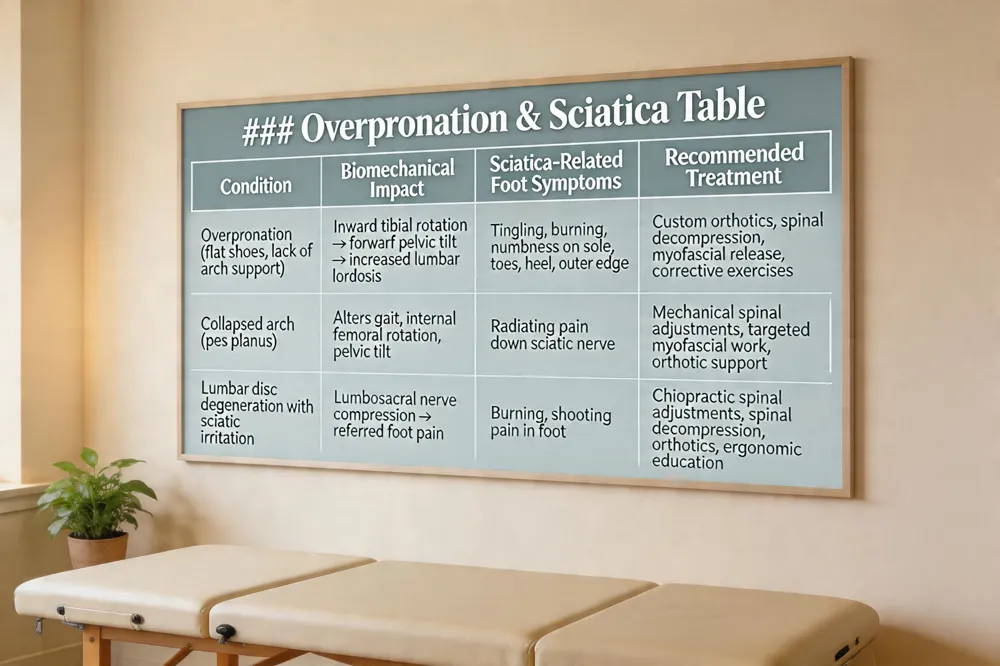 Flat shoes often lack arch support, allowing excessive pronation. This inward roll rotates the tibia, tilts the pelvis forward, and increases lumbar lordosis, forcing the lower back to compensate and creating chronic back pain. Likewise, collapsed arches (pes planus) alter gait and can irritate the sciatic nerve by increasing internal femoral rotation and pelvic tilt, leading to sciatica symptoms that radiate down the leg. Sciatica‑related foot pain typically appears on the sole, toes, heel, or outer edge of the foot, manifesting as tingling, numbness, or a burning sensation; see Sciatica description. When low‑back pain is accompanied by burning feet, the source is often lumbosacral nerve irritation from disc degeneration or spinal stenosis; chiropractic evaluation and spinal decompression therapy, myofascial release techniques, corrective exercises, and custom orthotics can address the biomechanical chain and relieve both back and foot discomfort.
Footwear Choices: Flat Shoes, High Heels, and Orthotics
Footwear Impact Table
| Footwear Type | Arch Support | Pelvic Tilt Effect | Recommended Action |
|---|---|---|---|
| Flat flip‑flops / unsupportive flats | Minimal to none | Inward tibial rotation → anterior pelvic tilt | Use custom‑made orthotics or supportive arch‑type shoes |
| High heels (≥3 in) | Shifts centre of mass forward, reduces heel contact | Increases lumbar lordosis & pelvic tilt | Limit heel height, alternate with low‑heel shoes, incorporate orthotic inserts |
| Orthotic‑compatible shoes (e.g., supportive trainers) | Restores medial arch height | Neutralizes pronation, reduces pelvic tilt | Continue supportive footwear, periodic FPI assessment |
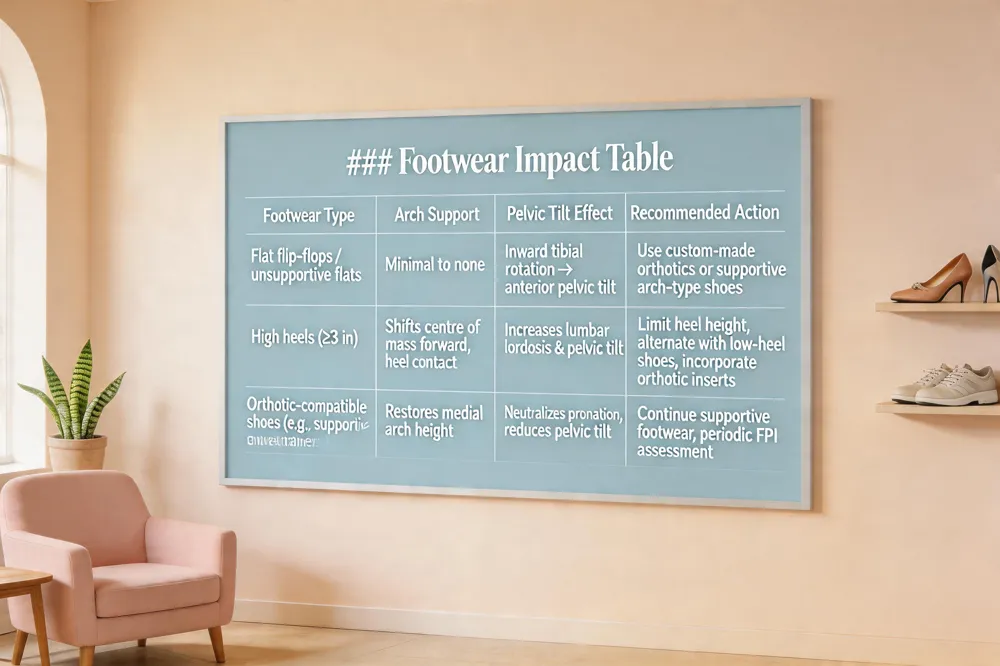 Unsupportive shoes—flat flip lacking arch support, high heels that push the centre of mass forward—collapse the medial arch and force the tibia to rotate inward. This creates an anterior pelvic tilt, increases lumbar lordosis and loads the lower back. Custom‑made orthotics restore medial arch height, distribute pressure evenly, and limit excessive pronation, resulting in measurable reductions in low‑back pain within 4–6 weeks. The Foot Posture Index (FPI) is a six‑item clinical tool that scores rear‑foot and fore‑foot positions from –2 to +2; the total score classifies the foot as pronated, neutral or supinated. Dr Allison Ross uses the FPI during the initial exam to pinpoint abnormal foot mechanics and to decide whether orthotics, myofascial release, corrective exercises or a foot chiropractic adjustment are indicated. By matching the FPI result to a personalized treatment plan, patients achieve better alignment, less spinal strain and long‑term relief.
Therapeutic Interventions: Chiropractic, Orthotics, and Exercise
Therapeutic Interventions Overview
| Intervention | Target Area | Mechanism of Action | Expected Benefit |
|---|---|---|---|
| Spinal decompression | Lumbar discs, nerve roots | Reduces intradiscal pressure, improves circulation | Decreased disc irritation, nerve pain relief |
| Low‑level laser therapy | Soft tissue, inflammation | Photobiomodulation → enhanced cellular metabolism | Reduced inflammation, faster tissue healing |
| Myofascial release | Fascia, muscular tension | Stretching & pressure release → improved tissue glide | Less muscular guarding, improved range of motion |
| Custom orthotics | Foot arch, gait | Realigns foot, neutralizes pronation/supination | Lowered lumbar lordosis, reduced pelvic tilt |
| Core stability & hip abductor exercises | Core, hips, intrinsic foot muscles | Strengthening → maintains neutral pelvis | Prevents recurrence of back/foot pain |
| Dr. Allison Ross’s integrated protocol | Whole kinetic chain | Combines adjustments, laser, orthotics, exercises | Holistic, drug‑free pain relief |
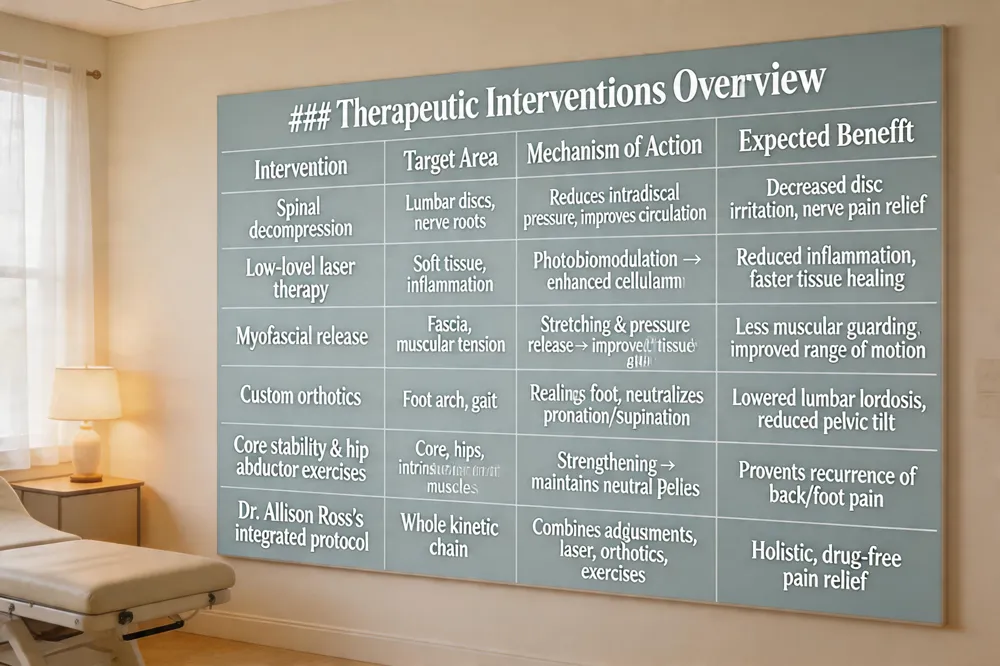 Spinal decompression, low‑level laser, and myofascial release address disc irritation and nerve inflammation by reducing pressure, improving circulation, and easing muscular guarding.
Custom orthotics realign the foot, neutralize excess pronation or supination, and restore a stable base that diminishes lumbar lordosis and pelvic tilt.
Corrective exercise programs target core stability, hip abductors, and intrinsic foot muscles to maintain alignment and prevent recurrence.
Neuropathy chiropractor near me – Dr. Allison Ross, DC in San Jose, CA combines spinal adjustments, cold‑laser therapy, myofascial release, and custom orthotics to improve peripheral nerve function and relieve tingling, numbness, and burning sensations.
What can a chiropractor do for your feet – Evaluate gait and foot mechanics, perform manual adjustments and soft‑tissue work, prescribe supportive orthotics, and teach strengthening drills (toe‑spreads, short‑foot) to correct plantar fasciitis, flat feet, and related issues.
Lower back pain due to plantar fasciitis – Altered gait from fasciitis forces lumbar spine strain; corrective orthotics and myofascial release alleviate both foot strain and compensatory back pain.
Podiatrist or chiropractor for foot pain – A podiatrist treats foot‑specific pathology, while a chiropractor addresses whole‑body biomechanical imbalances; integrated care yields the best outcomes.
Can a chiropractor help with neuropathy in the feet – Yes—spinal and foot adjustments, myofascial release, cold‑laser, and orthotics reduce nerve compression and improve circulation, diminishing pain and tingling.
Self foot adjustment – Not recommended; professional foot chiropractic adjustments by Dr. Ross ensure safety and effectiveness.
Integrative Care, Education, and Lifestyle
Lifestyle & Education Checklist
| Lifestyle Factor | Impact on Back/Foot Health | Practical Recommendation |
|---|---|---|
| Poor posture & ergonomics | Increases lumbar load, aggravates foot mechanics | Ergonomic workstation, posture training, regular chiropractic checks |
| Chronic stress & cortisol | Elevates inflammation, muscle tension | Relaxation techniques, adequate sleep, regular spinal care |
| Occupational repetitive bending (e.g., mechanics) | Repeated lumbar strain, potential disc issues | Use proper lifting mechanics, core strengthening, scheduled spinal decompression |
| Inadequate footwear choices | Alters gait, promotes pronation/supination | Choose shoes with arch support, cushioning; avoid worn high heels |
| Lack of patient education | Poor self‑management, higher relapse | Provide education on gait, footwear, exercises, and stress management |
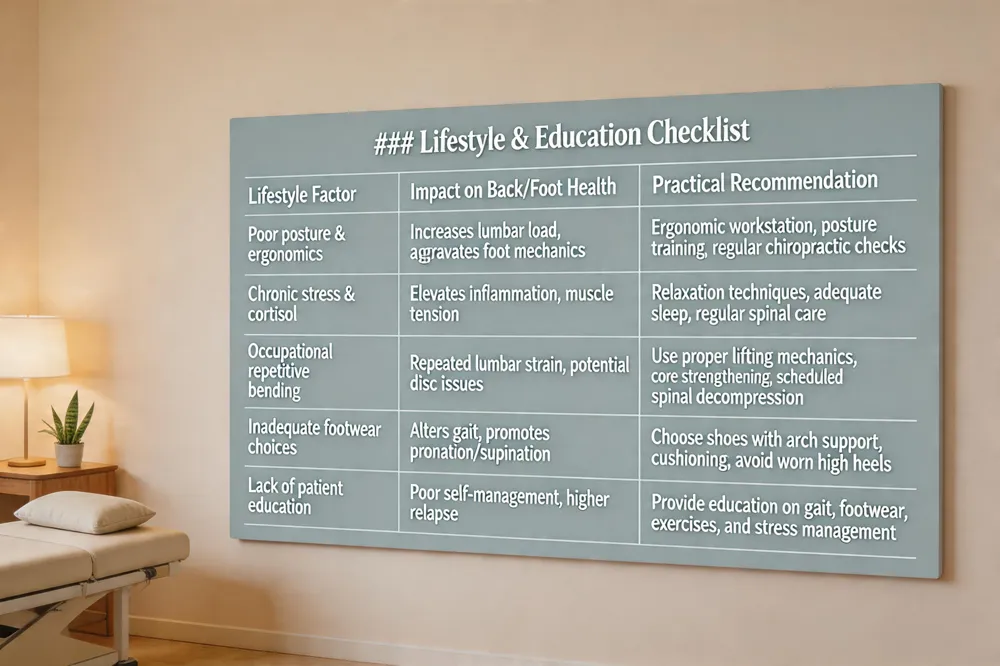 Patient education is the cornerstone of lasting back health. Chiropractors teach optimal posture, safe gait mechanics, and proper footwear selection—emphasizing arch support, cushioning, and avoiding high‑heeled or worn shoes that destabilize the kinetic chain. Stress and chronic cortisol elevation aggravate inflammation and muscle tension, especially in occupations that demand repetitive bending or heavy lifting; addressing these factors through relaxation techniques, ergonomic adjustments, and regular spinal care can normalize cortisol and reduce pain. Holistic,term prevention strategies combine spinal adjustments, myofascial release, corrective exercises for the core, hips, and intrinsic foot muscles, and custom orthotics to maintain neutral pelvic alignment.
Q: Can a chiropractor help with cortisol levels? A: Yes—by improving nervous‑system function, chiropractic care can lower stress‑induced cortisol, decreasing inflammation and supporting recovery.
Q: Can being a mechanic cause back pain? A: Repetitive bending, twisting, and heavy‑tool handling in automotive work place high demand on the lumbar spine, making mechanics prone to back and shoulder symptoms.
Q: Neuropathy chiropractor near me? A: Dr. Allison Ross, DC in San Jose, CA offers specialized neuropathy care, blending spinal adjustments, myofascial release, cold‑laser therapy, and custom orthotics to improve nerve function and relieve tingling, numbness, and burning sensations.
Putting It All Together
Foot mechanics drive the kinetic chain: overpronation or high arches rotate the tibia, tilt the pelvis, and increase lumbar lordosis, often leading to chronic low‑back pain. A practical plan starts with a gait analysis to pinpoint abnormal pressure patterns, followed by custom orthotics that restore neutral foot alignment and reduce compensatory pelvic tilt. Chiropractic adjustments then address residual lumbar or pelvic misalignments, while myofascial release and core‑hip strengthening reinforce the corrected posture. At Ross Chiropractic we combine these evidence‑based, drug‑free therapies into a personalized program that targets the root cause and helps patients regain pain‑free mobility.