What is Delayed Pain and Why It Matters
Delayed pain is discomfort that appears hours, days, or even weeks after an injury, most often after car accidents. The body’s fight‑or‑flight response floods the system with adrenaline and endorphins, which temporarily suppress pain signals. As these hormones wane, inflammatory mediators (swelling, cytokines) build up in soft tissues, nerves, and joints, unveiling the injury. Early evaluation—ideally within the first 48‑72 hours—allows clinicians to identify hidden damage, begin non‑surgical treatments such as physical therapy or chiropractic care, and prevent the transition to chronic pain.
Why Pain Can Be Delayed After an Accident
Timeline of Pain Development After an Accident
| Phase | Approx. Time After Injury | Primary Physiological Events | Typical Pain Experience |
|---|---|---|---|
| Immediate | 0‑5 min | Surge of adrenaline & endorphins → natural analgesia | Little to no pain, feeling “fine” |
| Early | 5 min‑6 h | Hormone levels drop, initial inflammatory mediators (histamine, bradykinin) appear | Mild discomfort or stiffness may begin |
| Early Inflammation | 6‑48 h | Accumulation of prostaglandins & cytokines, swelling starts | Swelling, bruising, dull ache |
| Peak Inflammation | 48‑72 h | Maximal cytokine activity, tissue edema | Sharp or throbbing pain, reduced range of motion |
| Late Phase | 3‑7 days | Tissue repair, scar formation, possible nerve irritation | Persistent soreness, occasional spikes of pain |
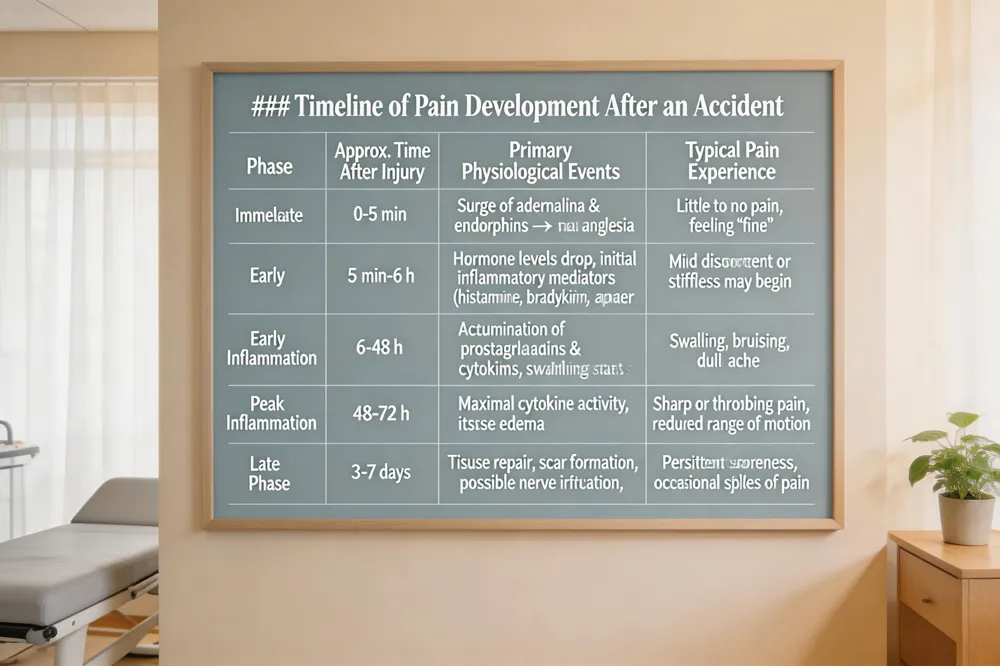 Pain from an injury can certainly be delayed. The body’s fight‑or‑flight response releases large amounts of Adrenaline and endorphins mask pain after accidents at the moment of trauma. These chemicals act as natural analgesics, temporarily numbing the nervous system and allowing a victim to feel fine for minutes or even hours after a crash. Once the stress‑hormone surge subsides, the hidden injury begins to reveal itself.
The inflammatory response follows a predictable timeline. Soft‑tissue damage—muscle strains, ligament sprains, tendon micro‑tears—does not generate noticeable pain until inflammatory mediators such as prostaglandins and cytokines accumulate. Swelling and bruising often start 6‑8 hours post‑injury and may not peak until 48‑72 hours, which explains why pain, stiffness, and limited range of motion commonly appear 24‑72 hours after the accident.
Fractures, by contrast, usually cause immediate, sharp pain because bone disruption triggers a rapid nociceptive signal. Fractures typically cause immediate, severe pain, whereas many car‑accident injuries involve soft tissues and therefore present delayed symptoms. Most car‑accident injuries, however, involve soft tissues, so the symptom onset is delayed. Patients who feel discomfort days after an accident should seek evaluation from a qualified medical professional, such as Dr. Ike Malik, who can diagnose the underlying cause and develop a treatment plan. Recognizing this pattern encourages patients to monitor for pain that emerges days later and seek evaluation from a qualified professional—such as a physiatrist or chiropractor—to prevent chronic complications.
Common Delayed Symptoms After Falls and Accidents
Typical Delayed Symptoms and Their Onset
| Symptom | Usual Onset After Incident | Underlying Cause |
|---|---|---|
| Headache, dizziness, light‑sensitivity | 24‑48 h | Mild traumatic brain injury, vascular changes |
| Neck/back stiffness, soreness | 24‑72 h | Whiplash, soft‑tissue strain, inflammatory mediator buildup |
| Sharp or radiating pain, numbness, tingling | 24‑72 h | Nerve irritation or compression from swelling |
| Mood changes (irritability, anxiety) | 48‑96 h | Decline of stress‑hormone flood, psychological stress response |
| Sleep disturbances | 2‑5 days | Central sensitization and heightened arousal |
 After a fall or a car crash, the surge of adrenaline and endorphins can mask injury for minutes to hours, so the first noticeable signs often appear later. Headache, dizziness, and concussion signs are classic delayed cues; patients may develop a throbbing headache, light‑sensitivity, or a feeling of spinning 24–48 hours after the impact, especially if a mild traumatic brain injury occurred. Neck and back stiffness, soreness, and nerve irritation follow a similar timeline: whiplash or soft‑tissue strain may not hurt immediately, but as inflammatory mediators accumulate swelling muscles, ligaments, and discs become swollen, leading to reduced range of motion, sharp or radiating pain, numbness, or tingling in the arms or legs. Psychological changes such as irritability, anxiety, or disrupted sleep emerge as the stress‑hormone flood subsides; the body’s fight‑or‑flight response fades, revealing underlying emotional strain that can amplify perceived pain.
What are delayed symptoms after a fall? Delayed symptoms can include headaches or dizziness that surface hours to days later, neck or back stiffness and sharp pain as inflammation builds, numbness or tingling that signals nerve involvement, and mood‑ or sleep‑related changes as stress hormones wane.
Is it normal to have back pain 3 weeks after a car accident? Yes. Persistent back pain three weeks post‑accident is common when soft‑tissue strain, ligament sprain, or subtle disc irritation is present. However, any pain lasting beyond a few days should be evaluated by a qualified professional to rule out more serious injury.
Specific Joint Delayed Pain: Knee, Shoulder, Lower Back
Delayed Joint Pain Overview
| Joint | Typical Delayed Onset | Common Injuries | Chiropractic Modalities |
|---|---|---|---|
| Knee | 24‑72 h | Soft‑tissue strain, micro‑fracture, meniscus irritation | Adjustments, myofascial release, cold‑laser therapy, corrective exercises |
| Shoulder | Hours‑weeks (often 48‑96 h) | Rotator‑cuff strain, bursitis, nerve irritation | Peripheral adjustments, myofascial release, low‑level laser, strengthening program |
| Lower Back | 24‑72 h | Muscle spasm, ligament sprain, disc irritation, pinched nerve | Spinal adjustments, decompression therapy, myofascial release, core‑stabilization exercises |
 Delayed knee pain after car accident often results from soft‑tissue strain, hidden micro‑fractures, or ligament and meniscus injury that was masked by the surge of adrenaline. As the stress response fades, inflammation and swelling develop over the next 24–72 hours, producing pain, stiffness, and limited motion. Early chiropractic care—adjustments to restore proper knee alignment, myofascial release to improve circulation, cold‑laser therapy to reduce cytokine activity, and corrective exercises—can diminish swelling and prevent chronic dysfunction.
Delayed shoulder pain after car accident appears hours, days, or weeks later because adrenaline and endorphins initially blunt pain signals. Common culprits include rotator‑cuff strains, bursitis, and nerve irritation that inflame gradually. Gentle spinal and peripheral adjustments, targeted myofascial release, low‑level laser therapy, and a personalized shoulder‑strengthening program help control inflammation, restore range of motion, and avoid frozen‑shoulder complications.
Delayed lower‑back pain after car accident often signals soft‑tissue injury, a strained disc, or a pinched nerve that was not evident until the adrenaline wore off. Muscle spasms, ligament sprains, or disc irritation become painful as inflammatory mediators accumulate. A comprehensive chiropractic assessment, spinal adjustments, decompression therapy, and myofascial release work together to realign vertebrae, relieve nerve pressure, and reduce the risk of chronic pain.
Psychological Factors: PTSD and Pain Amplification
PTSD‑Related Pain Amplification
| Psychological Factor | Effect on Pain Threshold | Mechanism | Suggested Interventions |
|---|---|---|---|
| PTSD / Hyper‑vigilance | Lowered threshold, heightened perception | Persistent cortisol & catecholamine release → peripheral nociceptor sensitization & central sensitization | Counseling, stress‑reduction techniques, chiropractic care (spinal decompression, myofascial release) |
| Anxiety / Fear of Re‑injury | Increased muscle tension, reflex guarding | Sympathetic nervous system activation → amplified nociceptive signaling | Guided relaxation, CBT, gentle adjustments, corrective exercises |
 Post‑Traumatic Stress Disorder (PTSD) lowers pain thresholds by keeping the nervous system in a constant state of alarm. Heightened anxiety, hyper‑vigilance, and the release of stress hormones such as cortisol and catecholamines sensitize peripheral nociceptors, making even mild tissue irritation feel painful. This heightened state can trigger central sensitization, where the spinal cord and brain amplify pain signals, turning normal healing sensations into chronic discomfort.
Can PTSD make pain worse? Yes—PTSD can amplify existing pain and generate new pain sensations. The combination of psychological stress and physiological hyper‑reactivity lowers the pain threshold, causing patients to experience more intense and widespread discomfort than would be expected from the original injury alone.
Do people go into physical pain when they start to recover from trauma? Yes. As the body moves from the acute shock phase to recovery, the nervous system may remain hypersensitive, firing pain signals even after tissues have healed. Fear of re‑injury and lingering stress further magnify this pain.
A holistic treatment plan that addresses both mind and body—counseling, stress‑reduction techniques, and non‑invasive chiropractic care such as spinal decompression, myofascial release, corrective exercises, and custom orthotics—helps reset neural pathways, reduces central sensitization, and restores a healthier pain perception.
Understanding Post‑Traumatic Pain and Treatment Options
Post‑Traumatic Pain Types & Chiropractic Options
| Pain Type | Origin | Typical Onset | Chiropractic Modalities |
|---|---|---|---|
| Nociceptive | Ongoing tissue inflammation, scar tissue | Days‑weeks after injury (48‑72 h peak) | Spinal adjustments, myofascial release, cold‑laser, orthotics |
| Neuropathic | Damaged nerves, adhesions compressing nerves | Can appear weeks later | Decompression therapy, targeted adjustments, nerve‑gliding exercises |
| Central Sensitization | Amplified CNS processing | May develop weeks‑months later | Whole‑body spinal adjustments, stress‑reduction, therapeutic exercise, counseling |
 Post‑traumatic pain meaning
Post‑traumatic pain is the lingering discomfort that persists after a physical injury has technically healed. It can be nociceptive—originating from ongoing tissue inflammation or scar‑tissue irritation—or neuropathic, arising from damaged nerves that continue to fire pain signals. Typical signs include swelling, heightened sensitivity, skin color or temperature changes, reduced joint range of motion, and sometimes burning or shooting sensations. The pain often emerges days after the event because adrenaline and endorphins mask early signals, while inflammatory cytokines (IL‑6, TNF‑α) and scar tissue formation gradually sensitize nociceptors.
Post‑traumatic pain meaning
Post‑traumatic pain is the lingering discomfort that persists after a physical injury has technically healed. It can be nociceptive—originating from ongoing tissue inflammation or scar‑tissue irritation—or neuropathic, arising from damaged nerves that continue to fire pain signals. Typical signs include swelling, heightened sensitivity, skin color or temperature changes, reduced joint range of motion, and sometimes burning or shooting sensations. The pain often emerges days after the event because adrenaline and endorphins mask early signals, while inflammatory cytokines (IL‑6, TNF‑α) and scar tissue formation gradually sensitize nociceptors.
Role of inflammation, scar tissue, and nerve injury Soft‑tissue micro‑tears trigger a cascade of prostaglandins and cytokines that peak 48‑72 hours post‑injury, leading to delayed swelling and pain. Scar tissue and adhesions can compress nerves weeks later, producing neuropathic pain or even complex regional pain syndrome. Central sensitization may develop, amplifying pain beyond the original tissue damage.
Non‑invasive chiropractic modalities Chiropractic care addresses delayed pain through spinal adjustments that restore proper joint alignment, reducing nerve irritation. Adjunct therapies—myofascial release, spinal decompression, cold laser (low‑level) therapy, and corrective exercises—enhance blood flow, break down adhesions, and modulate inflammatory mediators. Custom orthotics correct biomechanical imbalances, preventing compensatory strain that can trigger delayed symptoms.
Can a chiropractor make you tired? Yes. After an adjustment, many patients experience brief fatigue as increased blood flow and neural resetting raise metabolic demand. This tiredness signals the nervous system’s recovery and usually resolves within a few hours; staying hydrated and gentle movement can aid the process.
Takeaway: Listen to Your Body and Seek Timely Care
After a crash or fall, keep a log of any new aches, stiffness, tingling, or swelling that appears after the first 24‑48 hours. Even delayed discomfort can signal soft‑tissue strain, nerve irritation, or early inflammation that, if ignored, may evolve into chronic pain. Prompt, individualized chiropractic evaluation—using adjustments, myofascial release, and corrective exercises—helps restore alignment, reduce nerve pressure, and halt maladaptive patterns. Pair these hands‑on treatments with stress‑reduction, proper posture, and gentle movement to support both physical and mental overall healing.