Why Regular Adjustments Matter
Regular chiropractic adjustments provide a drug‑free, non‑invasive way to cut pain at its source. By gently realigning the spine, adjustments relieve nerve compression and muscle tension, often delivering immediate relief and reducing the need for medication. Restoring proper joint mechanics expands range of motion, allowing everyday activities and athletic performance to feel smoother and more fluid. Consistent care also corrects postural imbalances; improved spinal alignment diminishes “text neck,” hyperkyphosis, and related muscular strain, leading to a more upright, balanced stance. Beyond the musculoskeletal system, regular adjustments stimulate the nervous system, enhance circulation, and lower stress hormones, supporting better sleep, mood, and immune function. When paired with soft‑tissue therapies, corrective exercises, and ergonomic counseling, chiropractic care becomes a holistic wellness strategy that maintains long‑term mobility, prevents future injuries, and promotes overall health.
Finding the Right Care & Addressing Common Myths
 When you search for “chiropractic near me,” Ross Chiropractic in San Jose, CA, stands out as a convenient, patient‑focused option. Located at 1142 S Winchester Blvd, the practice led by Dr. Allison Ross, DC offers natural, non‑invasive musculoskeletal care—including spinal adjustments, decompression, myofascial release, cold‑laser therapy, corrective exercise programs, custom orthotics, and nutrition counseling. Patients with back pain, neck pain, sciatica, sports injuries, auto‑accident injuries, or pregnancy‑related discomfort report rapid symptom relief and long‑term wellness without surgery or drugs. To book, call (408) 247‑4503 or visit drallisonrossdc.com.
Regarding a deviated septum, chiropractic cannot physically straighten the nasal cartilage or bone, so it is not a permanent cure for the structural issue. However, gentle cranial and nasal‑specific adjustments can improve sinus drainage, reduce head‑and‑neck tension, and ease associated pain or congestion. At Ross Chiropractic, these light‑force techniques are combined with myofascial release, corrective exercises, and lifestyle education to help patients breathe easier. For severe deviations causing chronic blockage or sleep problems, an ENT evaluation and possible surgery remain the definitive treatment. Chiropractic can provide symptom relief, but it does not replace surgical correction when anatomy requires it.
Science, Skepticism, and the Body’s Response
 Chiropractic care sits at the intersection of evidence‑based practice and lingering pseudoscientific claims. The core technique—spinal manipulation—has modest but consistent support for acute low‑back pain, neck pain and tension‑type headaches, and migraine relief, as highlighted by the Cleveland Clinic and multiple systematic reviews. These studies show that controlled, precise adjustments improve joint motion, reduce nerve irritation, and can lower reliance on pain medication. However, a subset of practitioners still promotes the outdated concept of "vertebral subluxations" as the root of all disease, a notion many researchers label pseudoscientific. This division creates the ongoing debate: "Is chiropractic pseudoscience?" The answer is nuanced—while some methods lack strong data, many clinicians, such as Dr. Allison Ross, blend evidence‑back adjustments with adjunct therapies (myofascial release, cold laser, corrective exercises) that deliver real symptom relief, improved posture, and functional recovery.
Another common myth involves "detoxification" after an adjustment. Adjustments do not generate new toxins; instead, they may enhance circulation and lymphatic flow, allowing existing metabolic waste—like lactic acid and carbon‑dioxide—to be cleared more efficiently. Patients sometimes feel mild fatigue or soreness, which are temporary, self‑limiting responses. Hydration, gentle movement, and rest support the body’s natural elimination pathways, confirming that the so‑called "detox" is simply a normal physiological clearing process rather than a mysterious toxin release.
Safety Profile: Benefits vs. Risks
 Chronic adjustments are generally safe when performed by a licensed chiropractor. Side effects are usually mild and short‑lived, resembling post‑workout soreness: temporary stiffness, mild headache, fatigue, or occasional dizziness that typically resolve within 24‑48 hours (Cleveland Clinic). Potential complications are rare but can include worsening of a herniated disc, nerve irritation, or, in very uncommon cases, vertebral‑artery dissection leading to stroke; such serious events are overwhelmingly linked to untrained practitioners (Cleveland Clinic, Mayo Clinic). The benefit‑risk balance strongly favors treatment: adjustments provide immediate pain relief, improve range of motion, posture, and overall wellness, and reduce reliance on drugs and surgery (Cleveland Clinic, Harvard Health). Complementary therapies—myofascial release, cold laser, corrective exercises—enhance outcomes and further lower risk. While a few patients may experience temporary soreness and insurance coverage can vary, the incidence of severe adverse events is extremely low. Consequently, regular chiropractic care is considered a low‑risk, high‑reward option for managing musculoskeletal conditions and supporting long‑term health.
Targeted Care for Specific Conditions
 Regular chiropractic adjustments are a safe, non‑invasive way to maintain spinal alignment and support the nervous system, which in turn improves posture, reduces muscle tension, and promotes overall wellness (Cleveland Clinic; Ross Chiropractic). For sciatica, both physiotherapy and chiropractic care can be effective, but they work differently. Physiotherapy emphasizes inflammation control, posture correction, and core strengthening, which is ideal for mild cases. Chiropractic treatment focuses on correcting spinal misalignments with adjustments, myofascial release, and corrective exercises, often delivering faster relief for moderate to severe sciatica. A combined approach—initial physiotherapy to calm symptoms followed by chiropractic adjustments to restore alignment—usually yields the best outcome. Long‑term chiropractic care further sustains pain relief by continuously addressing subluxations, enhancing joint range of motion, and supporting nervous system function. Studies show that patients who receive ongoing care experience fewer episodes of back pain, sciatica, and degenerative joint issues, rely less on opioids, and enjoy better sleep, mood, and immune response (Cleveland Clinic; Harvard Health. In practice, clinicians like Dr. Allison Ross pair each adjustment with personalized education, ergonomic advice, and adjunct therapies such as spinal decompression and custom orthotics to maximize these lasting health benefits.
Post‑Adjustment Recovery Tips
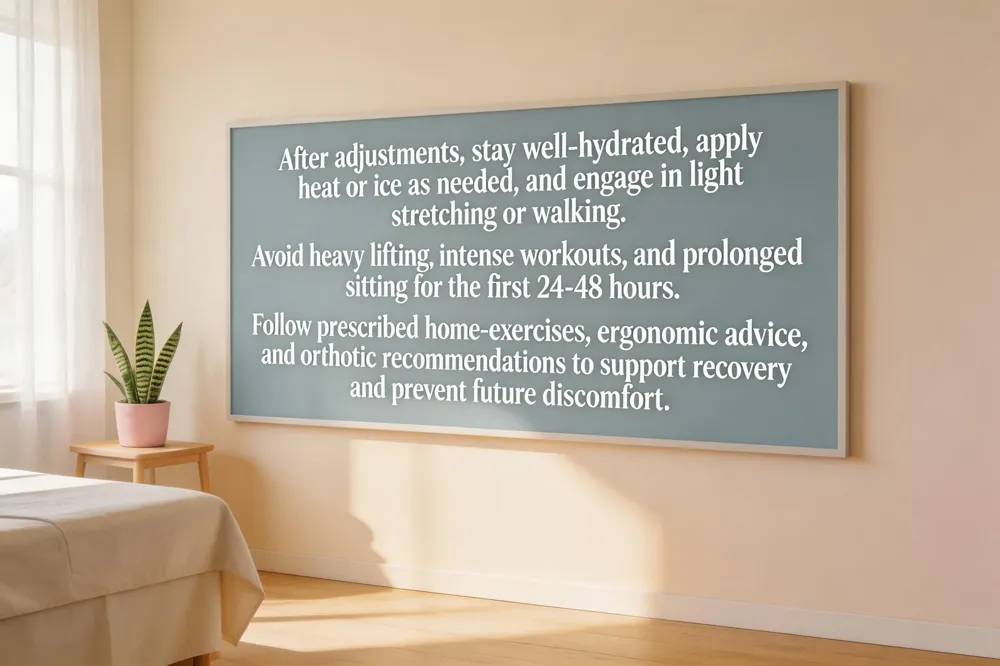 After a chiropractic adjustment most patients feel immediate relief, but mild soreness can linger for up to 24‑48 hours. To manage this, stay well‑hydrated—water helps flush out released toxins and keeps joints lubricated. Apply a gentle heat pack or ice pack to any tender area for 10‑15 minutes several times a day to ease muscle tension and reduce inflammation. Light, guided stretches and low‑impact activities such as walking promote circulation without overloading the newly aligned spine. Avoid heavy lifting, intense workouts, and prolonged sitting during the first day or two, and maintain good posture while you rest. Finally, follow any home‑exercise, ergonomic advice, or orthotic recommendations your chiropractor gave you to support the adjustment and prevent future discomfort.
A Path to Sustainable Health
At the core of modern chiropractic practice is personalized care. Each patient begins with a detailed history, physical exam and, when needed, diagnostic imaging, allowing the chiropractor to design a treatment plan that targets specific joint restrictions, muscular tension and postural habits. Integrative therapies complement the core adjustment: myofascial release, cold‑laser therapy, spinal decompression, corrective exercises and custom orthotics work together to enhance muscle relaxation, improve joint mechanics and accelerate tissue healing. By weaving these modalities into a regular schedule, clinicians create a preventive framework that supports long‑term mobility, better sleep and reduced reliance on pain medication. Looking ahead, this individualized, multimodal approach promises to become a cornerstone of wellness, helping patients maintain optimal nervous‑system function, lower chronic inflammation and achieve sustainable health without surgery or drugs. Future wellness plans will incorporate monitoring and tele‑health check‑ins to keep care proactive.