Why Understanding Care Matters
Symptom‑relief chiropractic focuses on short‑term pain reduction—using adjustments, cold laser, or manual therapy—to quickly restore motion and comfort. Corrective chiropractic, by contrast, seeks to identify and correct underlying spinal misalignments, load‑distribution problems, and postural deficits through objective measurements such as X‑ray analysis, posture assessment, and targeted rehabilitation exercises. Patients often expect immediate relief after an acute flare‑up, but they may be surprised to learn that lasting health depends on structural correction, not just temporary comfort. Long‑term implications include reduced recurrence, improved nerve function, better sleep, and enhanced overall resilience. Ross Chiropractic blends both models: an initial relief phase eases pain, then a structured corrective program—featuring precise adjustments, corrective traction, personalized exercises, and home‑care education—guides patients toward sustainable spinal health and functional wellness.
Symptom Relief Care: Quick Comfort, Not a Cure
Symptom Relief Care – Quick Comfort, Not a Cure
| Technique | Primary Purpose | Typical Immediate Outcome |
|---|---|---|
| High‑velocity adjustment | Restore joint motion, reduce nerve irritation | Rapid pain reduction, increased ROM |
| Spinal decompression | Re‑hydrate intervertebral discs, relieve pressure | Temporary height gain (0.5‑1 in), reduced stiffness |
| Cold‑laser therapy | Decrease inflammation, promote tissue healing | Quick comfort, less swelling |
| Myofascial release | Release muscle tension, improve flexibility | Immediate relief of muscle tightness |
| Personalized exercise program | Target source of discomfort, maintain gains | Enhanced functional movement, prevention of flare‑ups |
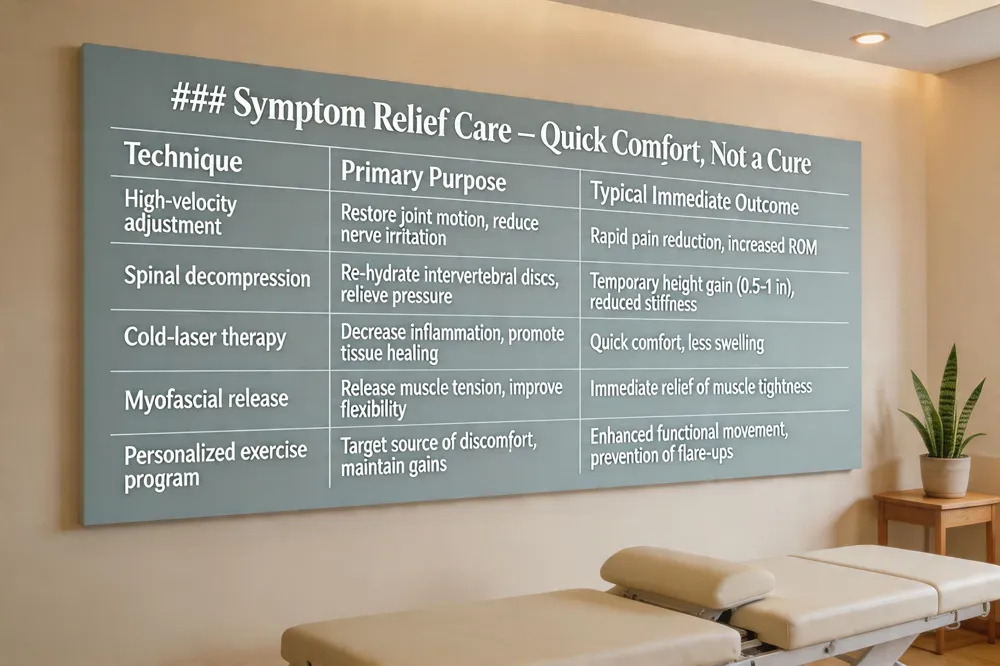 Short‑term pain reduction techniques
Symptom‑relief care aims to lower pain, stiffness, and inflammation quickly. Chiropractors use high‑velocity adjustments, spinal decompression, cold‑laser therapy, and myofascial release to restore joint motion and reduce muscle tension. These modalities give patients rapid functional improvement, especially during acute flare‑ups.
What does symptom relief mean?
Symptom relief refers to the reduction or elimination of uncomfortable signs—such as pain, stiffness, or fatigue—by improving immediate comfort and daily functioning. In a chiropractic setting, relief is achieved through adjustments, spinal decompression, myofascial release, cold‑laser therapy, and personalized exercise programs that target the source of discomfort. While the patient feels better quickly, the underlying structural cause may still remain unaddressed.
Why do doctors discourage chiropractors?
Some physicians are cautious because chiropractic is not always covered in medical curricula and because of concerns about high‑velocity neck manipulations. However, many doctors acknowledge the value of safe, evidence‑based spinal care for musculoskeletal conditions when performed by a licensed, well‑trained chiropractor. Open communication between medical and chiropractic providers helps ensure patients receive the most appropriate, coordinated care.
How many inches can you gain from decompressing your spine?
Spinal decompression can temporarily increase a patient’s height by about 0.5–1 inch as intervertebral discs rehydrate and expand. This change reflects restored disc spacing and is not permanent, but it illustrates how decompression relieves pressure on discs and nerves, supporting both symptom relief and the corrective process.
Limitations of focusing only on symptoms
When care stops at pain reduction, the root biomechanical imbalance often persists, leading to recurrent episodes. Without structural correction, patients may experience repeated flare‑ups and a higher long‑term pain.
Patient experience during acute flare‑ups
During an acute episode, patients typically feel immediate relief after an adjustment or laser session, allowing them to resume daily activities. However, without a follow‑up corrective plan, the underlying misalignment remains, raising the likelihood of future discomfort.
Corrective Chiropractic: Evidence‑Based Structural Healing
Corrective Chiropractic – Evidence‑Based Structural Healing
| Tool / Modality | Goal | Supporting Evidence |
|---|---|---|
| Posture analysis & digital X‑rays | Identify biomechanical imbalances | Baseline & progress tracking (research‑backed) |
| Sagittal balance assessment | Evaluate spinal curvature and load distribution | Correlates with reduced recurrence of back/neck pain |
| Targeted adjustments | Realign vertebrae, normalize nerve signaling | Lower long‑term pain rates vs. symptom‑only care |
| Rehabilitative exercises | Reinforce structural correction | Improves functional outcomes and durability |
| Lifestyle counseling (ergonomics, nutrition) | Support overall musculoskeletal health | Enhances maintenance of alignment |
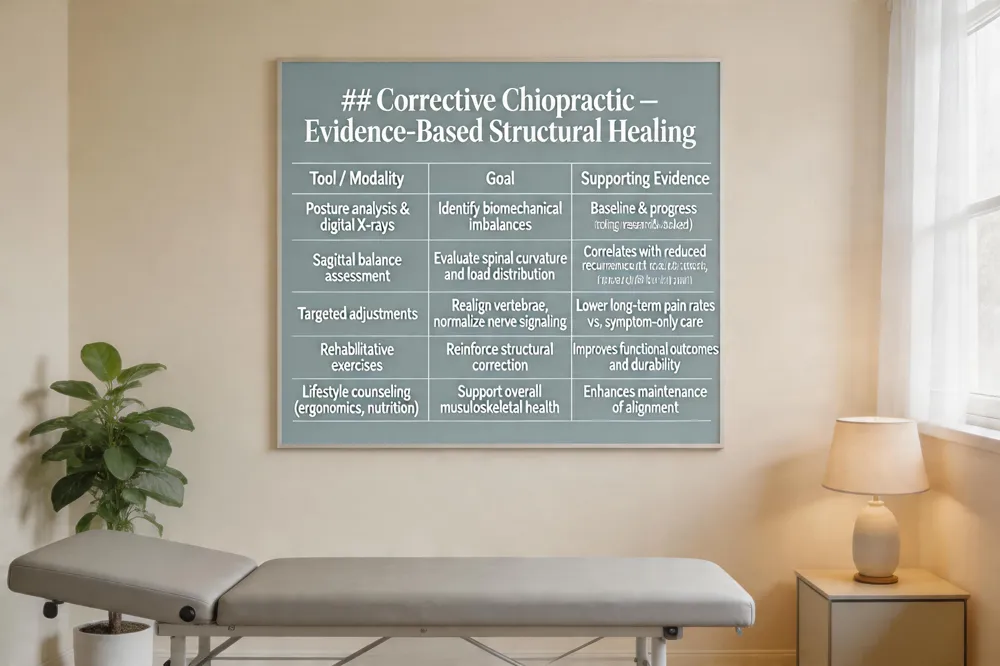 Corrective chiropractic is a legitimate, evidence‑based discipline that targets the structural causes of pain rather than merely masking symptoms. Practitioners use objective tools—posture analysis, digital X‑rays, and sagittal balance assessments—to establish a baseline and track changes over time. Research consistently shows that patients whose spinal alignment is corrected experience significantly lower recurrence rates of back and neck pain compared with those receiving only short‑term symptom relief.
Is corrective chiropractic legit? Yes. It employs imaging, precise adjustments, and supportive therapies to restore proper spinal curves and nerve function, delivering lasting relief.
What is a corrective chiropractor? A clinician who goes beyond temporary relief, using adjustments, rehabilitative exercises, soft‑tissue work, and lifestyle counseling to correct misalignments and improve long‑term wellness.
What is corrective therapy? A personalized program that combines targeted exercises, myofascial release, and modalities such as spinal decompression and cold‑laser therapy to address musculoskeletal imbalances and reinforce structural correction.
What are the 3 T’s in chiropractic? Thoughts, trauma, and toxins—primary contributors to subluxations. Trauma includes acute injuries and repetitive poor‑posture stress; toxins refer to harmful substances; thoughts encompass chronic stress that keeps the nervous system in a sympathetic state, all of which can disrupt alignment and health.
Adjustments and Their Direct Benefits
Adjustments and Their Direct Benefits
| Benefit | Description | Clinical Impact |
|---|---|---|
| Pain relief | Reduces pressure on irritated nerves | Immediate decrease in pain scores |
| Increased flexibility | Restores joint range of motion | Better movement quality, reduced stiffness |
| Improved posture | Aligns spinal curves | Decreased mechanical stress on discs |
| Enhanced nerve signaling | Optimizes CNS communication | May improve sleep, energy, and overall wellness |
| Drug‑free, non‑invasive | No medications or surgery required | Lower risk of side effects, patient preference |
| Preventive effect | Regular adjustments inhibit future injuries | Long‑term reduction in flare‑ups |
 A spinal adjustment is a precise, hands‑on maneuver that restores proper joint alignment by applying a controlled, short‑duration thrust to a restricted vertebra. By correcting the mis‑alignment, the adjustment instantly reduces pressure on irritated nerves and tight muscles, leading to rapid pain relief and a noticeable increase in range‑of‑motion. This mechanical reset also improves nervous‑system communication; the spine’s restored biomechanics allow neural signals to travel more efficiently, supporting the body’s natural healing processes and enhancing overall function.
Benefits of chiropractic adjustments – Adjustments relieve pain, improve flexibility, and boost posture while being drug‑free and non‑invasive. They foster better nerve signaling, which can translate into better sleep, higher energy, and reduced reliance on medication. Regular visits help prevent future injuries and promote long‑term wellness.
Advantages and disadvantages – The primary advantages are quick pain reduction, increased mobility, and the prevention of future issues through structural correction. Patients often report improved overall wellness. Minor disadvantages include temporary soreness or stiffness after treatment; serious complications are rare when care is delivered by a qualified practitioner. A thorough initial assessment and personalized care plan minimize risks and ensure safe, effective outcomes.
From Relief to Correction: A Phased Treatment Timeline
From Relief to Correction – Phased Treatment Timeline
| Phase | Typical Duration / Visits | Main Activities | Primary Goal |
|---|---|---|---|
| Initial Stabilization & Pain‑Control | 1‑3 visits | Gentle adjustments, cold‑laser, soft‑tissue work, light stretching | Reduce acute inflammation & pain |
| Structural Correction | 4‑12 visits (varies) | Posture analysis, sagittal‑balance imaging, targeted adjustments, corrective traction, rehab exercises | Realign vertebrae, restore load distribution |
| Maintenance / Wellness Care | Ongoing (monthly‑quarterly) | Periodic adjustments, home‑exercise reinforcement, ergonomic coaching | Preserve alignment, prevent recurrence |
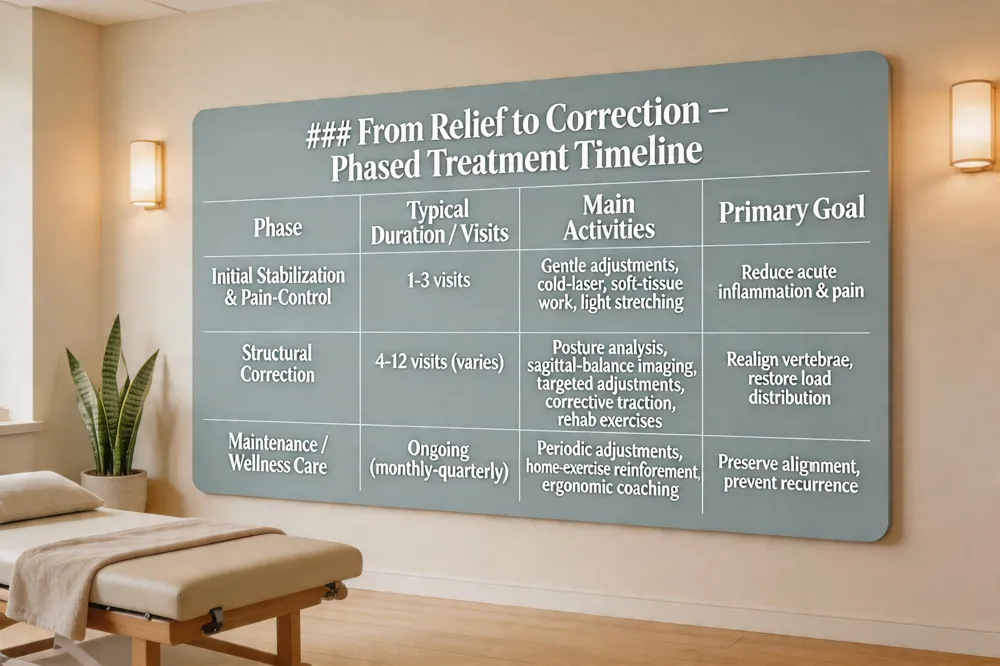 The corrective chiropractic journey begins with an initial stabilization and pain‑control phase. During these first few visits, the chiropractor uses gentle adjustments, cold‑laser therapy, and targeted soft‑tissue work to calm inflammation and reduce acute discomfort. This short‑term symptom relief creates a safe window for the patient to engage in light stretching and posture awareness, preventing the pain from flaring up again.
Once pain is manageable, the structural correction phase starts. Objective tools—posture analysis, sagittal‑balance imaging, and repeat X‑rays—establish a baseline. Targeted adjustments, corrective traction, and personalized rehabilitation exercises work together to realign vertebral curves and redistribute load. Progress exams at regular intervals compare current metrics to the baseline, ensuring that the spine’s geometry, not just pain scores, is improving.
After achieving measurable alignment gains, the plan transitions to maintenance or wellness care. Monthly or quarterly visits keep the spine in its new, healthier position while fine‑tuning any minor regressions. The patient’s role is pivotal: consistent home‑exercise routines, ergonomic adjustments at work, and ongoing posture monitoring reinforce the clinician’s work and sustain long‑term results.
How many inches can you gain from decompressing your spine? Spinal decompression can temporarily increase a patient’s height by about 0.5–1 inch as the intervertebral discs rehydrate and expand. This temporary change reflects restored disc spacing, which also reduces nerve irritation and improves overall biomechanics—key goals of the corrective phase.
Research‑Backed Outcomes and Maintenance Care
Research‑Backed Outcomes & Maintenance Care
| Study (Year) | Sample | Intervention | Key Finding |
|---|---|---|---|
| PLOS ONE randomized trial (2018) | 328 patients with non‑specific low‑back pain | Maintenance‑care program vs. symptom‑guided care | Maintenance group reported significantly fewer bothersome pain days over 52 weeks |
| Longitudinal imaging study (2020) | 210 chronic neck‑pain patients | Structural correction with X‑ray monitoring | Reduced disc degeneration progression and lower recurrence rates |
| Systematic review of spinal manipulation (2022) | 45 RCTs | High‑velocity adjustments + rehab | Consistent short‑term pain relief; long‑term benefits linked to corrective protocols |
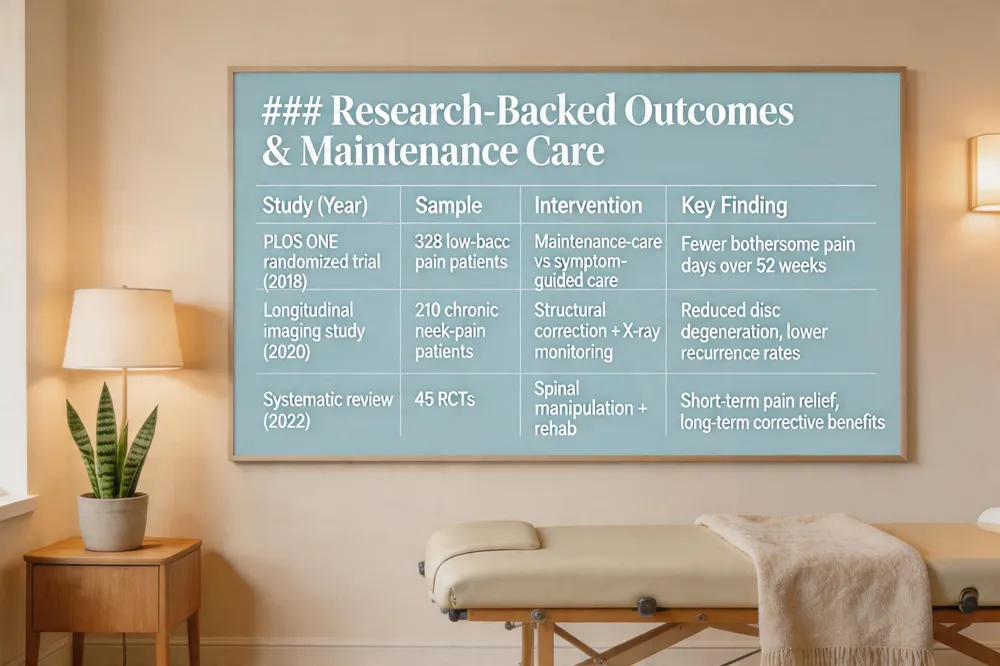 Multiple peer‑reviewed studies demonstrate that structural correction lowers pain recurrence. A 2018 PLOS ONE randomized trial followed 328 patients with non‑specific low‑back pain; those who entered a maintenance‑care program (regular adjustments after initial relief) reported significantly fewer bothersome pain days over 52 weeks compared with a symptom‑guided group, confirming the value of ongoing corrective visits. Other research shows that correcting spinal alignment reduces abnormal mechanical stress on discs, joints, and nerves, thereby slowing degenerative changes and improving long‑term functional resilience. Neurologists generally acknowledge that chiropractic care can be effective for mechanical back and neck pain, especially when it addresses spinal alignment and nerve irritation. However, they advise caution with high‑velocity cervical adjustments and emphasize the need for evidence‑based practice, thorough assessment, and coordination with medical care when indicated. Together, these findings support a phased approach: initial symptom relief, targeted structural correction, and scheduled maintenance to preserve alignment, prevent flare‑ups, and sustain overall musculoskeletal health.
Your Personalized Journey at Ross Chiropractic
Your Personalized Journey at Ross Chiropractic
| Step | Assessment | Interventions | Metrics Tracked |
|---|---|---|---|
| Intake & Baseline | Medical history, detailed posture analysis, X‑rays | Personalized structural rehab plan | Alignment angles, disc height, baseline pain scores |
| Active Correction | Progress exams (every 2‑4 weeks) | Targeted adjustments, corrective traction, myofascial release, cold‑laser, custom exercises | Change in ROM, functional movement scores, pain reduction |
| Education & Home‑Care | Ergonomic & nutrition counseling | Home‑exercise program, posture reminders | Adherence rate, self‑reported comfort |
| Maintenance Phase | Periodic check‑ups (monthly/quarterly) | Ongoing adjustments, fine‑tuning exercises | Long‑term alignment stability, flare‑up frequency |
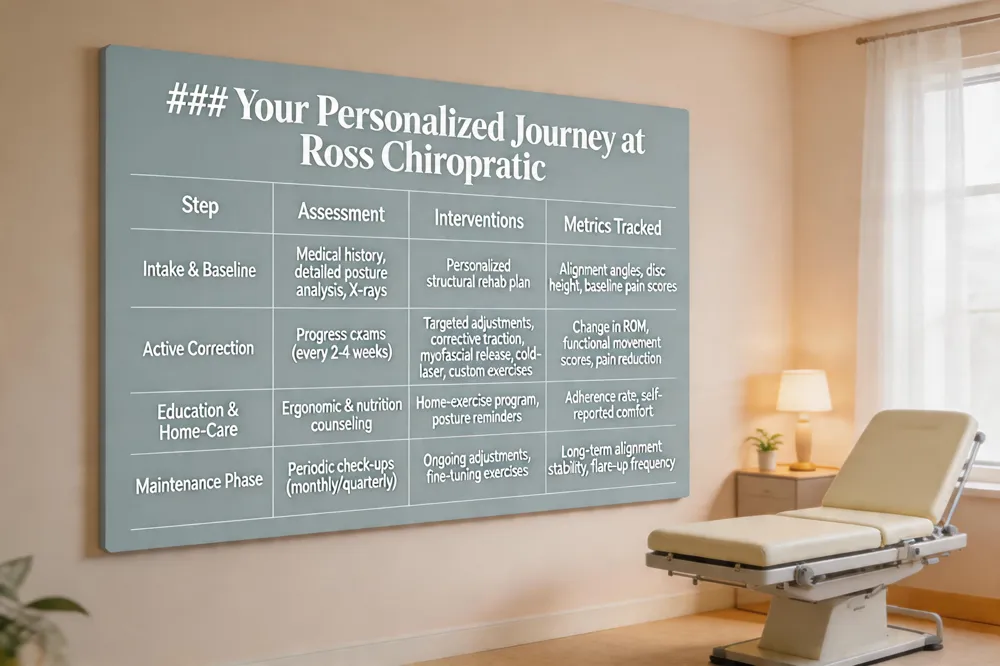 At Ross Chiropractic, every patient begins with a thorough intake and baseline assessment that captures medical history, conducts detailed posture analysis, and utilizes imaging such as X‑rays to pinpoint structural deviations. This data fuels an individualized structural rehabilitation plan that blends targeted spinal adjustments, corrective traction, myofascial release, cold laser therapy, and customized exercise protocols designed to restore optimal spinal curves and load distribution. Throughout the program, progress exams evaluate changes in alignment, functional movement, and objective metrics—beyond merely tracking pain scores—to confirm that the spine is healing as intended. Patients receive education on ergonomics, nutrition, and home‑care strategies, empowering them to maintain posture and support tissue health between visits. Once structural goals are met, the focus shifts to a wellness‑maintenance phase, featuring periodic check‑ups, continued corrective exercises, and lifestyle coaching that sustain long‑term spinal health and prevent recurrence of discomfort.
Choosing the Right Path for Your Spine
Finding the best approach for spinal health means weighing quick relief against lasting structural change. Immediate comfort—achieved through adjustments, cold‑laser or decompression—helps patients move again, but without addressing the underlying misalignment the pain often returns. Successful corrective programs depend on active patient participation: regular home exercises, posture awareness, and education about biomechanics turn the clinic’s work into lasting results. Ross Chiropractic follows this blended model. Initial sessions provide symptom relief while a structured assessment establishes a baseline; subsequent phases introduce targeted adjustments, traction, corrective exercises and custom orthotics, guiding patients from short‑term comfort to long‑term wellness.