Understanding Myofascial Release
Myofascial Release (MFR) is a hands‑on manual‑therapy technique that applies gentle, sustained pressure to the myofascial connective tissue with— restrictions adhesions, trigger points, and scar tissue, thereby restoring normal tissue glide and reducing pain. Fascia is a continuous, spider‑web‑like network that envelops muscles, bones, nerves, vessels and organs; when it becomes thick, sticky, or adherent it can limit range of motion, compress nerves, and amplify nociceptive signaling, contributing to chronic neck and back pain. A typical professional MFR session lasts 15‑50 minutes, with the therapist holding pressure on each restriction for 90‑120 seconds to promote thixotropy and tissue hydration. Qualified providers include chiropractors, physical therapists, occupational therapists, licensed massage therapists, sports‑medicine specialists, athletic trainers, and osteopathic physicians, all of whom must receive specialized training in fascia‑based techniques before treating patients.
The Science Behind Myofascial Release
 Fascia is a continuous, three‑dimensional web of connective tissue that surrounds muscles, nerves, vessels and organs. Its gel‑like ground substance (hyaluronan) can become viscous, limiting glide; sustained pressure during Myofascial Release (MFR) thins this gel, converting the fascia from a gel‑like to a more fluid state (thixotropy) and restoring normal sliding. The gentle, constant stretch activates mechanotransduction pathways: fibroblasts respond to deformation by releasing nitric oxide and other vasodilators, which increase local blood flow and lymphatic drainage, while inflammatory mediators such as substance P are down‑regulated. This cascade reduces tissue edema, eases trigger‑point tension, and modulates nociceptive signaling. Clinically, MFR is low‑risk: adverse events are rare and usually limited to temporary soreness. Contraindications include acute fractures, open wounds, deep‑vein thrombosis, active infection, severe osteoporosis, and uncontrolled bleeding disorders. When performed by trained clinicians, MFR can be safely integrated into multimodal, drug‑free chiropractic care.
Evidence‑Based Benefits for Chronic Neck Pain
 Meta‑analyses of randomized trials report that myofascial release (MFR) yields a modest but statistically significant reduction in chronic neck‑pain intensity (p ≈ 0.03) and modest gains in cervical rotation (p ≈ 0.05) and right‑side lateral flexion (p ≈ 0.04). While pressure‑pain threshold is not reliably altered, patients experience measurable pain relief and functional improvement. Combining MFR with chiropractic adjustments amplifies these effects: the soft‑tissue work releases fascial adhesions, allowing adjustments to correct joint alignment more effectively and enhancing range of motion. Patient‑reported outcomes consistently show 30‑40 % pain reduction, higher Neck Disability Index scores, and satisfaction rates above 85 % when MFR is part of a multimodal, drug‑free plan. At Ross Chiropractic, gentle, non‑manipulative options such as spinal decompression, cold laser therapy, customized orthotics, and corrective‑exercise programs complement MFR, providing safe, personalized care for those preferring low‑force treatment. These evidence‑based modalities together support lasting relief and improved daily function.
Myofascial Release for Chronic Low Back Pain
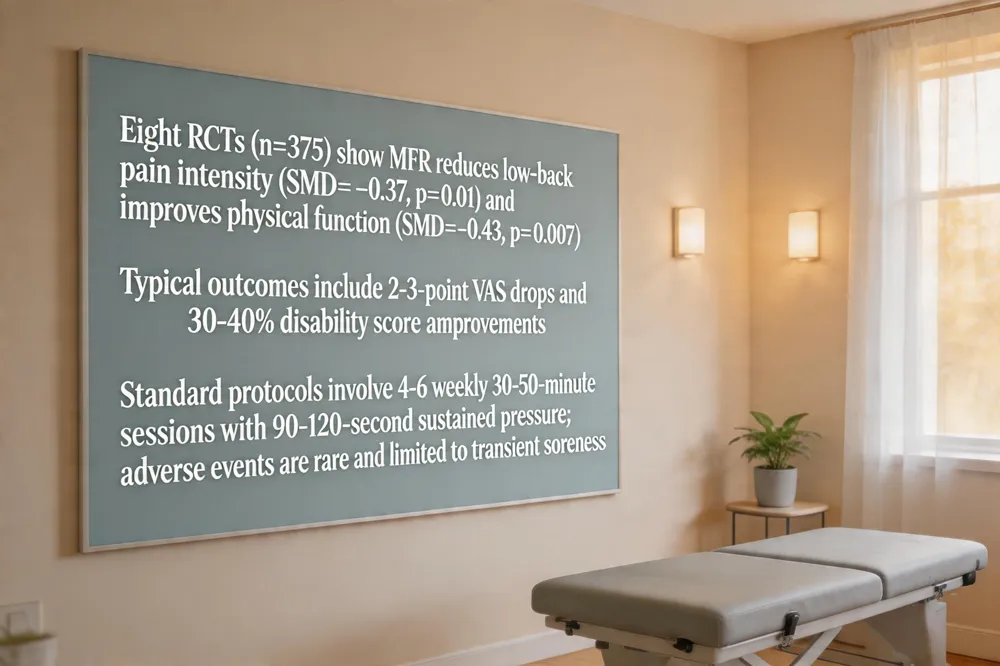 Randomized controlled trials consistently show that myofascial release (MFR) yields modest but statistically significant pain relief for chronic low back pain. In a meta‑analysis of eight RCTs (n = 375), MFR reduced pain intensity (SMD = ‑0.37, p = 0.01) and improved physical function (SMD = ‑0.43, p = 0.007). Individual trials report average Visual Analogue Scale drops of 2–3 points and disability score improvements of 30‑40% on the Oswestry and Roland‑Morris indices. Typical protocols involve 4‑6 weekly sessions lasting 30‑50 minutes each, with pressure held 90‑120 seconds per restriction; some studies use two‑day intervals for a total of eight 40‑minute treatments. Safety data are reassuring—adverse events are rare and usually limited to transient soreness; only one trial noted brief increased pain that resolved without medication. In summary, MFR provides a low‑risk, drug‑free option that meaningfully lowers pain intensity and disability when delivered in short, frequent courses, supporting its inclusion in multimodal chiropractic care plans.
Proprioceptive Activation and Trigger‑Point Physiology
 Myofascial release (MFR) works by stimulating the two primary proprioceptive organs in muscle: the muscle spindle and the Golgi tendon organ. Muscle spindles, embedded within fibers, detect changes in length and trigger reflexive contraction, while Golgi tendon organs at the tendon‑muscle junction sense tension and invoke the inhibitory stretch reflex. Sustained, gentle pressure during MFR stretches the fascia, concurrently activating both receptors, which helps the nervous system reset abnormal muscle tone and improve joint glide.
The reset of tone occurs through modulation of gamma‑motor drive and increased afferent input that promotes balanced activation of postural muscles, leading to better alignment and reduced compensatory strain. This mechanism underlies the observed improvements in cervical and lumbar range of motion after MFR.
Chronic myofascial pain syndrome arises when repetitive stress, poor posture, or mental tension creates hyper‑irritable trigger points—tight knots of contracted muscle fibers. These points generate localized ischemia, inflammatory mediator buildup, and referred pain patterns. Persistent trigger‑point activity maintains a cycle of muscle guarding and neural sensitisation, perpetuating chronic pain.
Integrating Myofascial Release into a Holistic Chiropractic Plan
 At Ross Chiropractic in San Jose, the care model is patient‑focused and drug‑free, using myofascial release (MFR) as a core soft‑tissue modality. MFR gently applies sustained pressure to fascia, breaking adhesions, improving blood flow, and reducing inflammatory mediators, which translates into measurable pain relief and increased cervical and lumbar range of motion. When MFR is combined with spinal decompression, cold laser therapy, and corrective exercises, the treatment synergistically restores joint mobility, enhances tissue healing, and supports postural correction. Clinical evidence indicates that manual therapies, including MFR and chiropractic adjustments, can lower cortisol, the primary stress hormone, promoting relaxation and a more balanced mood. This stress‑reduction effect contributes to overall well‑being and may decrease reliance on medication. Myofascial release is a legitimate, evidence‑based therapy endorsed by professional bodies such as the American Physical Therapy Association and practiced by licensed chiropractors, physical therapists, and osteopathic physicians. By integrating MFR with other non‑invasive interventions, Ross Chiropractic delivers a comprehensive, natural solution for chronic neck and back pain while supporting long‑term health.
Your Path to Pain‑Free Mobility
Extensive research shows that Myofascial Release (MFR) consistently lowers pain scores and improves range of motion for chronic neck and back pain, with randomized trials reporting 2‑3 point VAS reductions and modest gains in disability indices. Because MFR is a gentle, non‑invasive manual technique, it can be safely tailored to each individual’s tissue response—adjusting pressure, duration, and frequency—to complement spinal adjustments, corrective exercises, and ergonomic counseling. This personalized, drug‑free approach empowers patients to pursue gentle chiropractic care that restores mobility, reduces reliance on medication, and supports long‑term spinal health.