Understanding the Kinetic Chain
Foot mechanics form the foundation of the body’s kinetic chain. Overpronation or high arches alter tibial rotation, causing pelvic tilt and increased lumbar lordosis, which places extra shear on the lower back. Conversely, proper arch support and neutral foot strike distribute forces evenly, reducing compensatory stress up the chain. Because the spine, hips, knees, and ankles are inter‑dependent, addressing only the back often leaves the true source of strain uncorrected. A holistic strategy that combines biomechanical foot assessment, custom orthotics, gait retraining, and chiropractic adjustments restores alignment from the ground up, offering more durable relief for chronic low‑back pain.
Foot Problems That Trigger Lower Back Pain
| Foot Issue | Biomechanical Effect | Resulting Back Issue | Intervention |
|---|---|---|---|
| Over‑pronation / flat feet | Collapse of medial arch → tibia/femur internal rotation → anterior pelvic tilt → increased lumbar lordosis | Shear forces on lumbar vertebrae, disc stress | Custom orthotics, short‑foot drills, calf stretches, chiropractic adjustments |
| High arches (pes cavus) | Rigid foot, poor shock absorption → upward impact through knees/hips | Overloading of lumbar spine → chronic low‑back discomfort | Shock‑absorbing midsoles, supportive shoes, orthotics, spinal adjustments |
| Posterior tibialis tendon dysfunction | Loss of pronation control → altered gait | Lumbar hyperextension/rotation | Orthotics, targeted strengthening, myofascial release |
| Plantar‑fasciitis | Inflammation alters gait, forward weight shift | Forward pelvic tilt, increased lumbar curvature | Orthotics, calf & plantar fascia stretches, spinal adjustments |
| Heel pain (Achilles tendinopathy, spurs) | Weight shifts anteriorly | Forward pelvic tilt, lumbar hyperlordosis | Orthotics, heel lifts, stretching, chiropractic care |
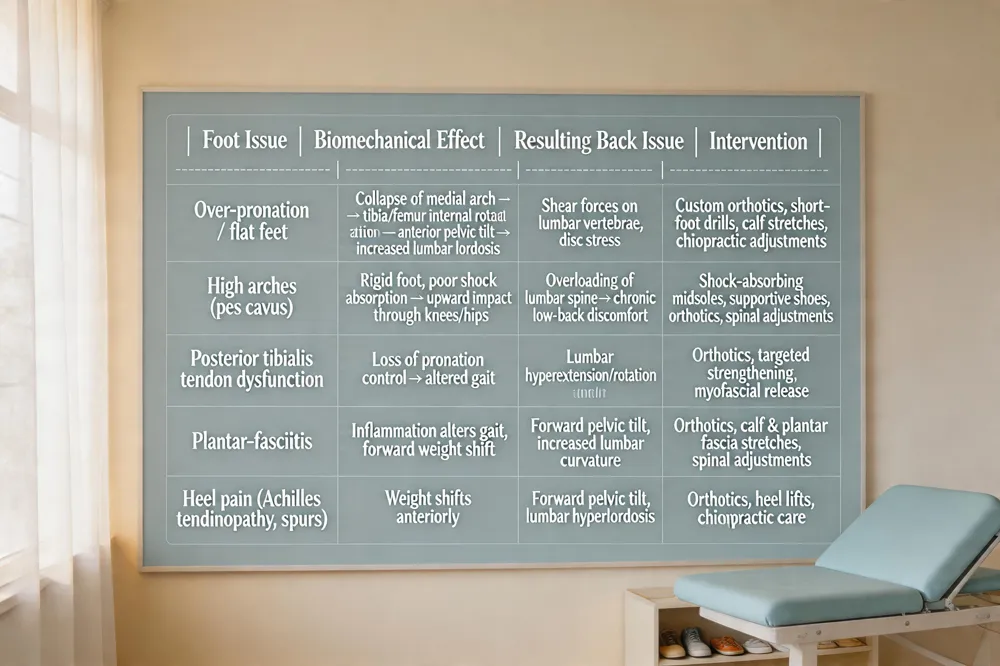 Over‑pronation and flat feet collapse the medial longitudinal arch, causing the tibia and femur to rotate inward. This internal rotation forces the pelvis into an anterior tilt, increasing lumbar lordosis and placing shear forces on the lumbar vertebrae. High arches (pes cavus) are rigid and absorb shock poorly; the resulting impact forces travel upward through the knees and hips, overloading the lumbar spine and often leading to chronic low‑back discomfort[https://pmc.ncbi.nlm.nih.gov/articles/PMC3828513/]. Posterior tibialis tendon dysfunction disrupts the foot’s ability to control pronation, while plantar‑fasciitis inflames the plantar fascia, both altering normal gait mechanics. The body compensates with lumbar hyperextension or rotation, creating muscle fatigue and disc stress. Persistent heel pain—whether from plantar‑fasciitis, Achilles tendinopathy, or heel spurs—shifts weight distribution forward, encouraging a forward pelvic tilt and increased lumbar curvature. These biomechanical cascades can be interrupted with custom foot orthotics that restore arch height and control pronation, targeted short‑foot drills, calf stretches, and chiropractic spinal adjustments that address resultant pelvic misalignments. Together, these interventions realign the kinetic chain, reduce abnormal loading on the lower back, and alleviate the associated pain.
Flat Feet, Sciatica and the Nerve Pathway
| Condition | Nerve Impact | Typical Symptoms | Management |
|---|---|---|---|
| Flat feet (excessive pronation) | Anterior pelvic tilt narrows sciatic tunnel → increased sheath tension | Radiating pain down posterior thigh, calf, foot; tingling | Custom‑molded orthotics, chiropractic adjustments, myofascial release, core‑hip stabilization |
| Sciatica (secondary to flat feet) | Compression/irritation of sciatic nerve | Sharp, shooting pain, numbness, weakness in leg | Orthotics + spinal adjustments, targeted stretching, neural glides |
| Nerve sheath irritation | Mechanical tension from altered biomechanics | Burning, electric‑shock sensations | Postural correction, footwear support, anti‑inflammatory modalities |
| Muscle fatigue (calf, hamstrings) | Compensatory over‑use due to altered gait | Tightness, reduced flexibility | Calf stretches, short‑foot drills, regular mobility work |
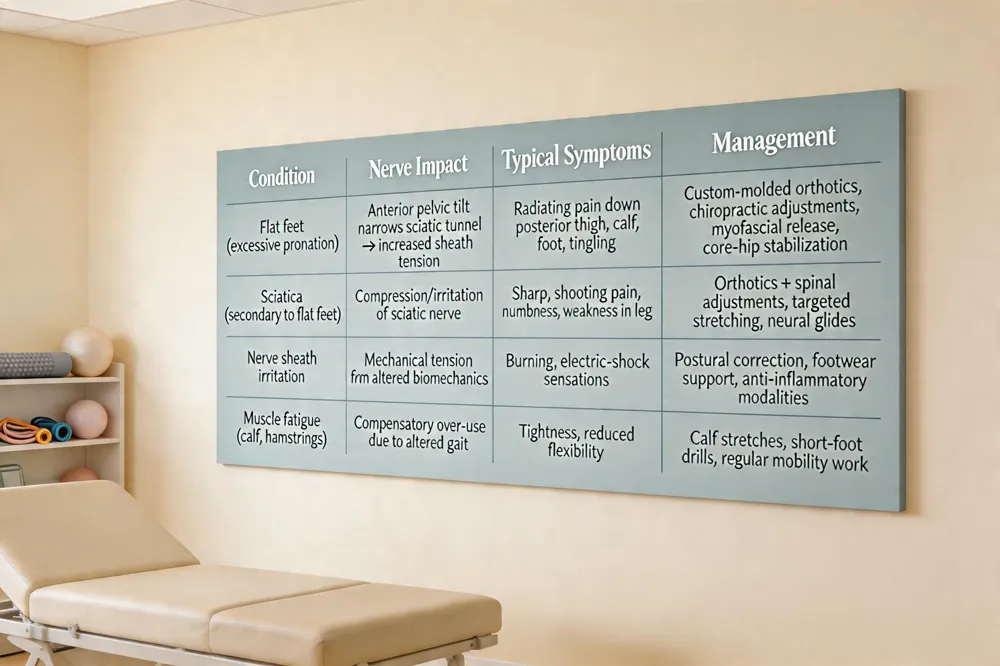 Flat feet, or collapsed arches, create excessive pronation that forces the tibia and femur into internal rotation. This rotation pulls the pelvis into an anterior tilt, narrowing the space through which the sciatic nerve travels and increasing tension on the nerve’s sheath. The resulting irritation can manifest as classic sciatica symptoms—sharp, radiating pain down the posterior thigh, calf, and foot—especially after prolonged standing or walking. Restoring neutral foot mechanics is therefore a key step in alleviating nerve compression. Custom‑molded orthotics provide arch support and control pronation, helping to re‑align the lower limb chain and normalize pelvic tilt. When combined with chiropractic spinal adjustments, myofascial release of the calf and plantar fascia, and targeted core‑hip stabilizing exercises, the pressure on the sciatic pathway is reduced and lumbar lordosis is moderated. This integrated, non‑invasive approach addresses both the distal trigger (flat feet) and the proximal response (lumbar strain), offering lasting relief for sciatica without reliance on medication or surgery.
Posture, Bad Habits and the Worst Things for Your Back
| Habit / Activity | Effect on Spine | Worst Outcome | Countermeasure |
|---|---|---|---|
| Slouching, hunching, unsupported sitting | Uneven load, flexed lumbar position | Chronic low‑back pain, facet joint irritation | Ergonomic chair with lumbar support, micro‑breaks, core strengthening |
| High‑impact sports (running, jumping) | Rapid repetitive forces on vertebrae/discs | Disc bulges, facet joint irritation | Low‑impact cardio, proper footwear, shock‑absorbing insoles |
| Heavy lifting with rounded back | Increased shear on discs, spinal flexion | Disc herniation, acute strain | Teach neutral spine lifting, core engagement, proper technique |
| Twisting under load | Rotational shear on lumbar segments | Facet joint arthropathy, disc degeneration | Avoid twisting, pivot with hips, use stable stance |
| Prolonged static sitting | Hamstring tightening, core weakening | Exacerbated lumbar lordosis, stiffness | Standing desk, periodic stretching, hip‑stability exercises |
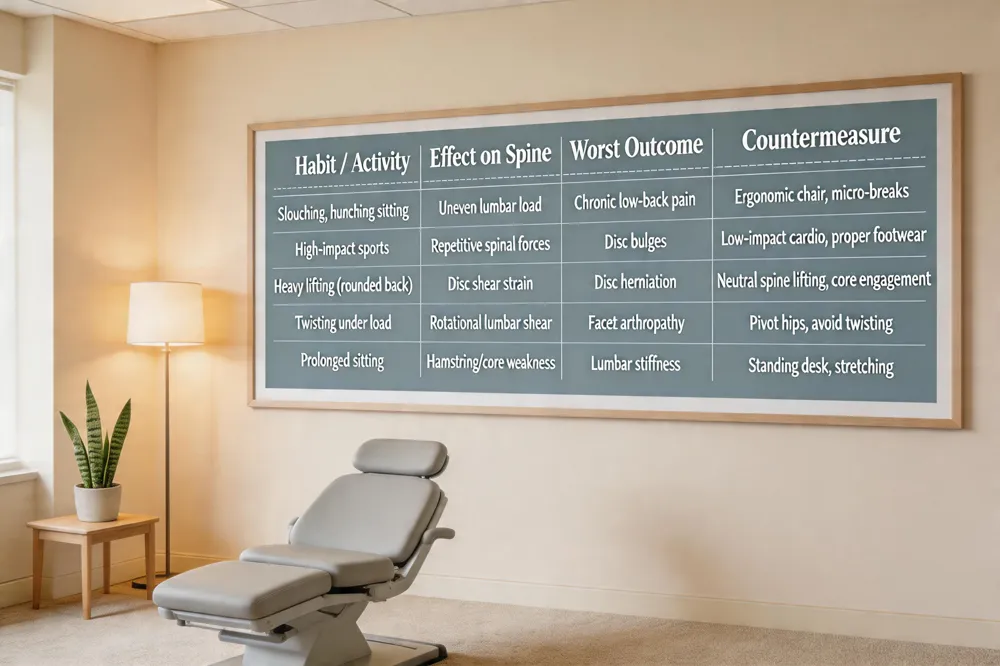 Slouching, hunching, and sitting without proper lumbar support place uneven loads on the lower spine, straining muscles, facet joints, and discs. Over time these stresses weaken supporting tissues and can lead to chronic low‑back pain or disc irritation. The problem is amplified when foot mechanics are poor; overpronation or high arches alter pelvic tilt and increase lumbar lordosis, adding further strain to an already compromised posture.
High‑impact activities such as running, jumping, or contact sports deliver rapid, repetitive forces to the lumbar vertebrae and intervertebral discs. Repeated heavy lifting with a rounded back or twisting motions under load can aggravate disc bulges and facet joint irritation. Even prolonged sitting without micro‑breaks forces the spine into a static, flexed position that tightens hamstrings and weakens core support, worsening the pain.
Ergonomic solutions include chairs with lumbar support, standing desks, and footwear that offers adequate arch support to maintain neutral alignment. Exercise strategies focus on core‑strengthening, hip‑stabilizing, and foot‑muscle activation (e.g., short‑foot drills, calf stretches) to restore proper kinetic‑chain mechanics. Myofascial release and targeted stretching of the calf and plantar fascia complement orthotic therapy, reducing compensatory pelvic tilt and lumbar strain.
Can poor posture cause lumbar pain? Yes. Slouching, hunching, or sitting without proper lumbar support places uneven loads on the lower spine, straining muscles, facet joints, and discs. Over time these stresses weaken supporting tissues and can lead to chronic low‑back pain or even disc irritation. Correcting posture with ergonomic adjustments, core‑strengthening exercises, and spinal‑alignment therapies helps restore proper mechanics and relieve the pain.
What's the worst thing you can do for lower back pain? The single worst thing is subjecting the lumbar spine to excessive, high‑impact forces—running, jumping, heavy lifting with a rounded back, or twisting under load—which can quickly aggravate inflammation and disc injury. Instead, focus on low‑impact movement, core strengthening, and regular micro‑breaks to promote healing and prevent further injury.
Red Flags, Insoles, Shoes and Foot‑Based Interventions
| Red Flag | Immediate Action | es | | | |---------------------------|-----------------| | Sudden severe pain after trauma | Seek emergency medical evaluation (possible fracture) | | New numbness/tingling/weakness in legs/feet | Urgent neurologic assessment | | Loss of bladder/bowel control | Emergency referral for possible cauda equina syndrome | | Fever, chills, unexplained weight loss with back pain | Rule out infection/tumor – urgent medical work‑up | | Pain worsening despite rest/OTC meds | Prompt professional evaluation for underlying pathology |
| Insoles Feature | Benefit |
|---|---|
| Firm arch support, deep heel cup | Aligns foot, reduces medial chain strain |
| Targeted cushioning (forefoot/posterior) | Distributes forces, eases knee/hip/lumbar load |
| Heat‑moldable or prescription‑grade | Customized fit after biomechanical assessment |
| Shock‑absorbing midsoles | Dampens impact, protects lumbar spine |
| Recommended Shoes |
|---|
| Brooks Ghost Max 3 |
| Hoka Bondi 9 |
| New Balance Fresh Foam X 880v15 |
| Vionic Walk Strider Knit |
| Orthofeet Coral Stretch Knit |
| Oofos Slides (rocker‑bottom) |
| Avoid: flip‑flops, high heels, unstable shoes |
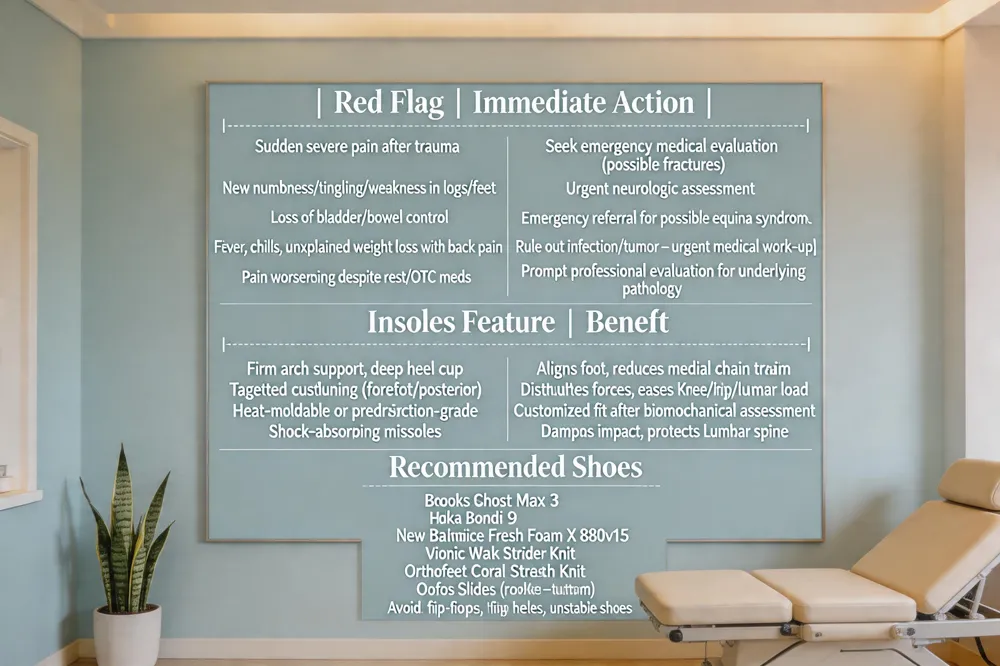 Red‑flag signs that need immediate care
- Sudden, severe pain after trauma (fall, car accident) suggesting fracture or serious injury.
- New numbness, tingling, or weakness in legs/feet indicating nerve compression.
- Loss of bladder or bowel control—possible cauda equina syndrome.
- Fever, chills, or unexplained weight loss with back pain, which may signal infection or tumor.
- Pain that persists or worsens despite rest, OTC meds, and conservative therapy.
Choosing the right insoles for knee and back health Custom‑fit orthotic insoles that offer firm arch support, a deep heel cup, and targeted cushioning are most effective. By aligning the foot and evenly distributing forces, they reduce strain up the kinetic chain to knees, hips, and lumbar spine. Heat‑moldable or prescription‑grade orthotics tailored after a biomechanical assessment provide the greatest long‑term relief.
Footwear recommendations for spinal alignment Select shoes with a firm heel counter, solid arch support, and shock‑absorbing midsoles. Examples include Brooks Ghost Max 3, Hoka Bondi 9, New Balance Fresh Foam X 880v15, and Vionic Walk Strider Knit. Orthopedic options such as Orthofeet Coral Stretch Knit and rocker‑bottom models like Oofos Slides also help. Avoid flat flip‑flops, high heels, or unstable shoes that exacerbate lumbar strain.
Foot Posture Index (FPI‑6) as a diagnostic tool The FPI‑6 scores six observable foot characteristics from –2 to +2, yielding a total that classifies the foot as supinated, neutral, or pronated. Clinicians use it to identify biomechanical patterns contributing to knee, hip, or low‑back pain, guide orthotic selection, and monitor therapeutic progress.
Plantar Fasciitis, Disc Issues, and Targeted Treatments
| Issue | Disc Level (if applicable) | Foot Symptoms | Treatment |
|---|---|---|---|
| Plantar fasciitis | – | Heel pain, morning stiffness, altered gait | Custom orthotics, calf & plantar fascia stretch, myofascial release, chiropractic adjustment |
| L4‑L5 disc problem | L4‑L5 | Tingling/ painness in inner ankle & arch (L4); foot drop risk | Core conditioning, targeted stretching, orthotic support, spinal manipulation |
| L5‑S1 disc herniation | L5‑S1 | Pain/numbness down calf, heel, outer foot; weak dorsiflexion | Orthotics, nerve glides, spinal adjustments, core‑hip stabilization |
| General back‑foot pain | – | Worsening pain while walking, calf over‑use | Arch‑support orthotics, calf stretching, myofascial release, chiropractic care |
| Integrated approach | – | – | Custom orthotics + targeted stretching + spinal adjustments = restored biomechanics, reduced lumbar stress |
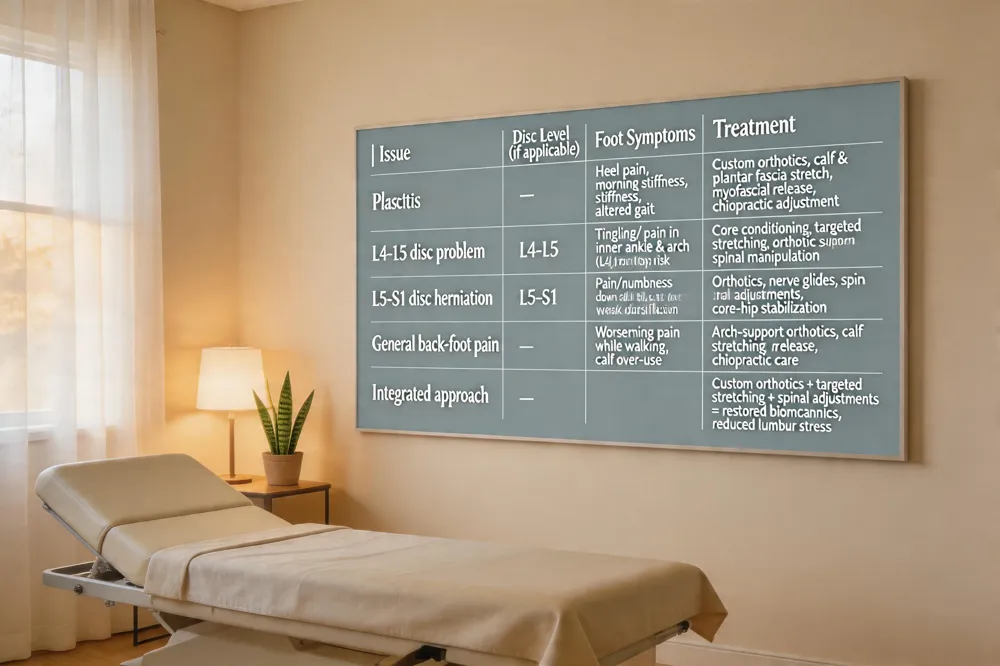 Plantar fasciitis often forces the foot into excessive pronation or an altered gait, shifting the center of gravity forward and loading the lumbar spine. This compensatory strain can cause muscle imbalances, tighten hip flexors, and irritate the sacroiliac joint, leading to lower‑back discomfort.
An L4‑L5 disc problem may compress the L4 or L5 nerve roots, producing radiculopathy that travels down the sciatic nerve. L5 involvement typically creates sharp pain or tingling on the top of the foot and toes, while L4 irritation affects the inner ankle and arch. Severe cases can lead to foot drop.
An L5‑S1 disc herniation pressures the S1 (and sometimes L5) root, sending pain, tingling, or numbness down the calf into the heel and outer foot. Weak dorsiflexion and a foot‑drop‑type gait may result, especially with prolonged standing or walking.
Back‑foot pain often worsens while walking because each step transmits cumulative mechanical strain through the spine, pelvis, and foot. Misaligned foot mechanics force calf and Achilles muscles to work harder, aggravating inflamed heel tissues and nerve irritation.
Effective treatments combine custom orthotics that support the arch and redistribute pressure, myofascial release and targeted stretching of the calf and plantar fascia and chiropractic spinal adjustments that correct lumbar and pelvic alignment. This integrated approach restores proper biomechanics, reduces lumbar stress, and alleviates both heel and lower‑back pain.
Aligning Feet, Aligning Life
The kinetic chain links foot posture directly to pelvic tilt, lumbar lordosis, and back strain—flat feet, high arches, or excessive pronation can all drive low‑back pain. A drug‑free, comprehensive plan that combines custom orthotics, gait retraining, supportive footwear, myofascial release, and targeted strengthening restores proper alignment, reduces lumbar loading, and improves overall mobility. Take the first step toward lasting relief: schedule a personalized biomechanical evaluation to identify your foot‑spine imbalances and receive a tailored, non‑invasive treatment protocol.