The Rise of Digital Foot Scanning in Chiropractic Practice
Digital foot scanning uses laser triangulation, structured‑light or handheld infrared sensors to capture a three‑dimensional model of the foot in seconds. The system records exact bony contours, arch height, heel width and pressure distribution, often with sub‑millimetre precision (0.1‑0.4 mm) that far exceeds traditional plaster casts. Accurate geometry is critical because custom orthotics must match the patient’s foot anatomy to redistribute load, correct pronation or supination and preserve the windlass mechanism. Even a few millimetres of error can create pressure hotspots, reduce comfort and diminish therapeutic benefit. At Ross Chiropractic, the scan is performed in a non‑weight‑bearing, neutral position, allowing a painless, quick assessment while the clinician still conducts a full gait and posture analysis. The digital file is instantly emailed to a certified orthotics lab, shortening turnaround time to days and enabling remote collaboration. Integrated with spinal adjustments, myofascial release, corrective exercises and patient education, the 3‑D scan becomes a cornerstone of Ross’s drug‑free, holistic care model, ensuring that foot mechanics are precisely aligned with the entire kinetic chain.
Benefits and Accuracy of a Foot Scan
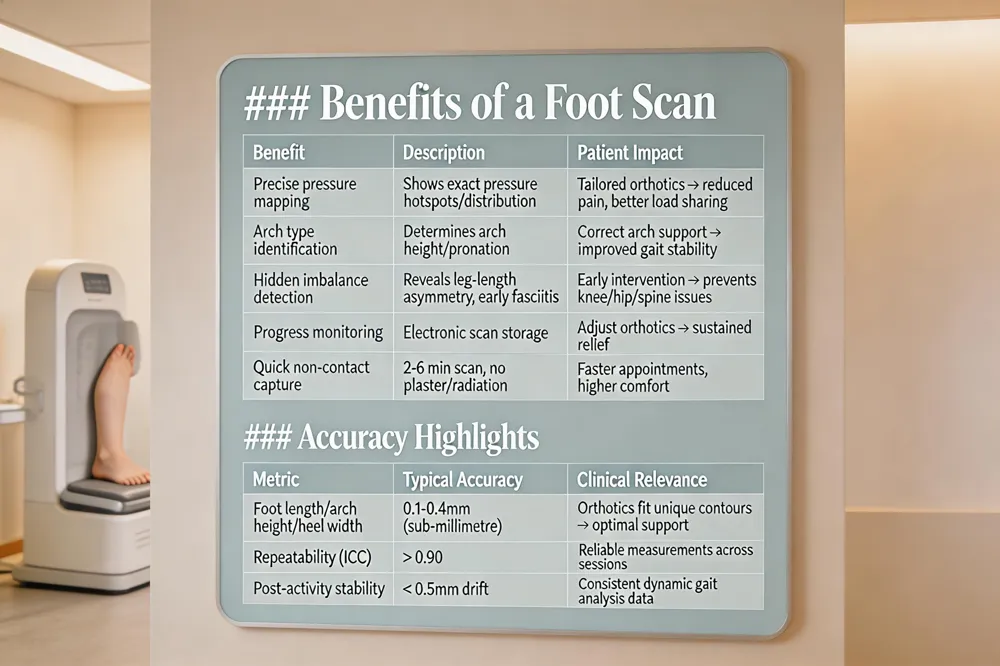
Benefits of a Foot Scan
| Benefit | Description | Patient Impact |
|---|---|---|
| Precise pressure mapping | Shows exact pressure hotspots and distribution across foot zones | Tailored orthotic zones → reduced pain and better load sharing |
| Arch type identification | Determines arch height, pronation/supination status | Supports correct arch support → improved gait stability |
| Hidden imbalance detection | Reveals leg‑length discrepancies, asymmetries, early plantar fasciitis | Early intervention → prevents progression to knee/hip/spine issues |
| Progress monitoring | Stores scans electronically for longitudinal comparison | Adjust orthotics as biomechanics change → sustained relief |
| Quick, non‑contact capture | 2‑6 min scan, no plaster or radiation | Faster appointments, higher patient comfort |
Accuracy Highlights
| Metric | Typical Accuracy | Clinical Relevance |
|---|---|---|
| Foot length, arch height, heel width | 0.1 mm – 0.4 mm (sub‑millimetre) | Ensures orthotics fit unique contours → optimal support |
| Repeatability (ICC) | > 0.90 | Reliable measurements across sessions |
| Post‑activity stability | < 0.5 mm drift | Consistent data for dynamic gait analysis |
 What are the benefits of a foot scan?
A foot scan delivers a precise map of pressure distribution, arch type, and gait patterns, exposing hidden imbalances that can trigger pain and postural issues. By visualizing static stance, dynamic walking, and balance tests, clinicians can pinpoint excess stress or abnormal movement in the feet, ankles, knees, hips, and spine. This detailed data enables Dr. Allison Ross to design custom orthotics and targeted therapeutic exercises that correct alignment, reduce strain, and promote healthier biomechanics. Patients experience faster relief from foot, knee, hip, or lower‑back discomfort, improved mobility, and enhanced performance. Regular scans also allow monitoring of progress, catching subtle changes before they become symptomatic and helping to prevent future injuries.
What are the benefits of a foot scan?
A foot scan delivers a precise map of pressure distribution, arch type, and gait patterns, exposing hidden imbalances that can trigger pain and postural issues. By visualizing static stance, dynamic walking, and balance tests, clinicians can pinpoint excess stress or abnormal movement in the feet, ankles, knees, hips, and spine. This detailed data enables Dr. Allison Ross to design custom orthotics and targeted therapeutic exercises that correct alignment, reduce strain, and promote healthier biomechanics. Patients experience faster relief from foot, knee, hip, or lower‑back discomfort, improved mobility, and enhanced performance. Regular scans also allow monitoring of progress, catching subtle changes before they become symptomatic and helping to prevent future injuries.
Are foot scans accurate? Yes. Modern 3D foot scanners achieve sub‑millimetre precision—studies report accuracies of 0.1 mm to 0.4 mm and repeatability scores above 0.90 for key dimensions such as foot length, arch height, and heel width. Independent research confirms that measurements remain stable even after activity, making the technology reliable for orthotic design. This high level of accuracy ensures that custom orthotics fit the unique contours of each foot, providing optimal support and durability.
Precise mapping of pressure and arch type The digital model captures exact arch geometry and pressure hotspots, allowing clinicians to tailor support zones, heel wedges, and metatarsal pads for balanced load distribution.
Detection of hidden imbalances Scanning reveals subtle leg‑length discrepancies, asymmetries, and early signs of plantar fasciitis that are invisible to the naked eye.
Monitoring progress over time Electronic storage of scans enables longitudinal comparison, facilitating adjustments to orthotics as the patient’s gait or condition evolves.
Pros, Cons, and Value of 3D Scanning
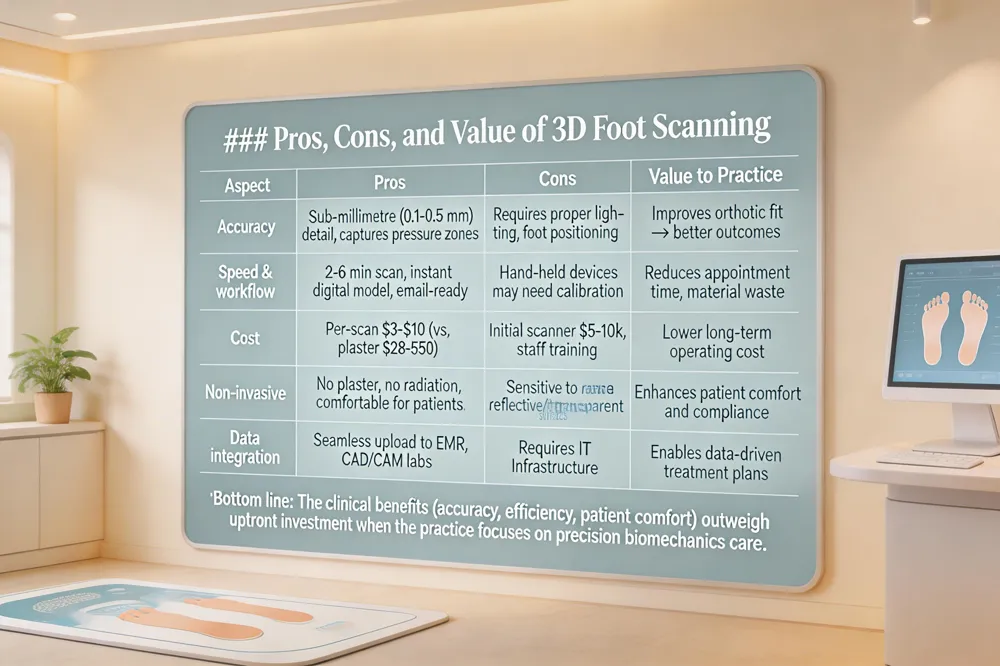
Pros, Cons, and Value of 3D Foot Scanning
| Aspect | Pros | Cons | Value to Practice |
|---|---|---|---|
| Accuracy | Sub‑millimetre (0.1‑0.5 mm) detail, captures pressure zones | Requires proper lighting, foot positioning | Improves orthotic fit → better outcomes |
| Speed & workflow | 2‑6 min scan, instant digital model, email‑ready | Hand‑held devices may need calibration | Reduces appointment time, material waste |
| Cost | Per‑scan $3‑$10 (vs. plaster $28‑$50) | Initial scanner $5‑$10k, staff training | Lower long‑term operating cost |
| Non‑invasive | No plaster, no radiation, comfortable for patients | Sensitive to reflective/transparent surfaces | Enhances patient comfort and compliance |
| Data integration | Seamless upload to EMR, CAD/CAM labs | Requires IT infrastructure | Enables data‑driven treatment plans |
Bottom line: The clinical benefits (accuracy, efficiency, patient comfort) outweigh the upfront investment when the practice focuses on precision biomechanics care.
 High‑precision, non‑contact measurement: Modern 3D foot scanners capture the foot’s exact contours with sub‑millimetre accuracy (0.1–0.5 mm) by laser, structured light, or triangulation. This level of detail reproduces arches, heel width, and pressure distribution, allowing orthotics to match the patient’s anatomy far better than plaster casts or manual calipers.
Speed and workflow efficiency: A scan takes 2–6 minutes (often under a minute for handheld devices) and instantly creates a digital model that can be emailed to a lab. The rapid turnaround shortens appointment time, reduces material waste, and enables same‑day gait‑analysis integration, so clinicians spend more time on assessment and patient education.
Cost, training, and material limitations: Initial scanner purchase ($5,000‑$10,000) and staff training add overhead, while per‑scan costs ($3‑$10) remain far lower than plaster casting ($28‑$50). The technology requires proper lighting and foot positioning; reflective, dark, or transparent surfaces can degrade data quality, and clinicians must be skilled in point‑cloud processing.
What are the pros and cons of 3D scanning? It delivers ultra‑accurate, non‑invasive foot models that improve orthotic fit, gait‑analysis insight, and patient comfort, but it demands capital investment, trained operators, and careful environmental control.
Is 3D foot scanning worth it? Evidence shows 3D scans are more reliable than traditional methods, reduce waste, and enhance clinical outcomes—making the investment justified for practices focused on precise, drug‑free, biomechanical care.
Custom Orthotics: Impact on Gait and Design Methodology
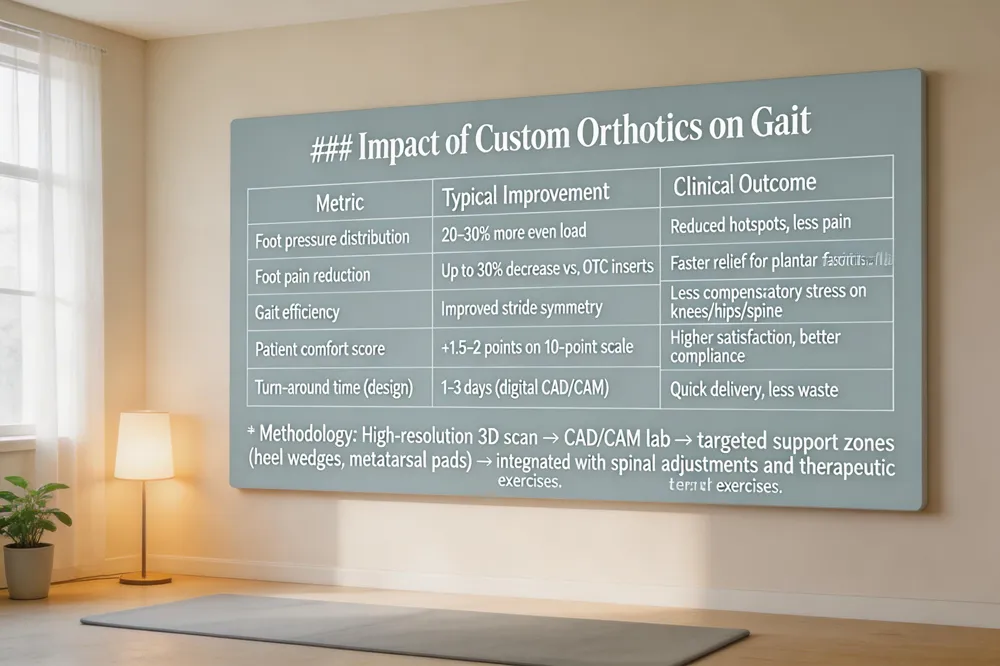
Impact of Custom Orthotics on Gait
| Metric | Typical Improvement | Clinical Outcome |
|---|---|---|
| Foot pressure distribution | 20‑30 % more even load | Reduced hotspots, less pain |
| Foot pain reduction | Up to 30 % decrease vs. OTC inserts | Faster relief for plantar fasciitis, flat feet |
| Gait efficiency | Improved stride symmetry | Less compensatory stress on knees/hips/spine |
| Patient comfort score | +1.5‑2 points on 10‑point scale | Higher satisfaction, better compliance |
| Turn‑around time (design) | 1‑3 days (digital CAD/CAM) | Quick delivery, less waste |
Methodology: High‑resolution 3D scan → CAD/CAM lab → targeted support zones (heel wedges, metatarsal pads) → integrated with spinal adjustments and therapeutic exercises.
 Custom orthotics are a powerful tool for correcting gait mechanics. By delivering precise, three‑dimensional support that matches a patient’s unique foot anatomy, they realign the foot and ankle, diminish over‑pronation or supination, and prevent compensatory patterns that strain the knees, hips, and lower back. Studies show orth improve improve foot pressure distribution by 20‑30 % and can reduce foot pain by up to 30 % compared with over‑the‑counter inserts, leading to smoother, more efficient strides.
The best technique for creating these devices now relies on high‑resolution 3D foot scanning. Modern scanners achieve accuracy within 0.1‑0.4 mm, capture the exact contours of the plantar surface, and can be performed in a non‑weight‑bearing, neutral position for patient comfort. The digital model is instantly transmitted to a CAD/CAM laboratory, where targeted support zones, heel wedges, and metatarsal pads are engineered. This workflow shortens turnaround time to a few days, eliminates material waste, and stores the scan for longitudinal monitoring.
Clinical outcomes reported by patients include higher comfort scores, reduced hot‑spot incidence, and faster relief from conditions such as plantar fasciitis, flat feet, and knee pain. At Ross Chiropractic, orthotics are integrated with spinal adjustments, myofascial release, and corrective exercises, creating a holistic, drug‑free approach that sustains long‑term gait improvement without surgery.
Five Foot‑Related Symptoms Not You Should Ignore
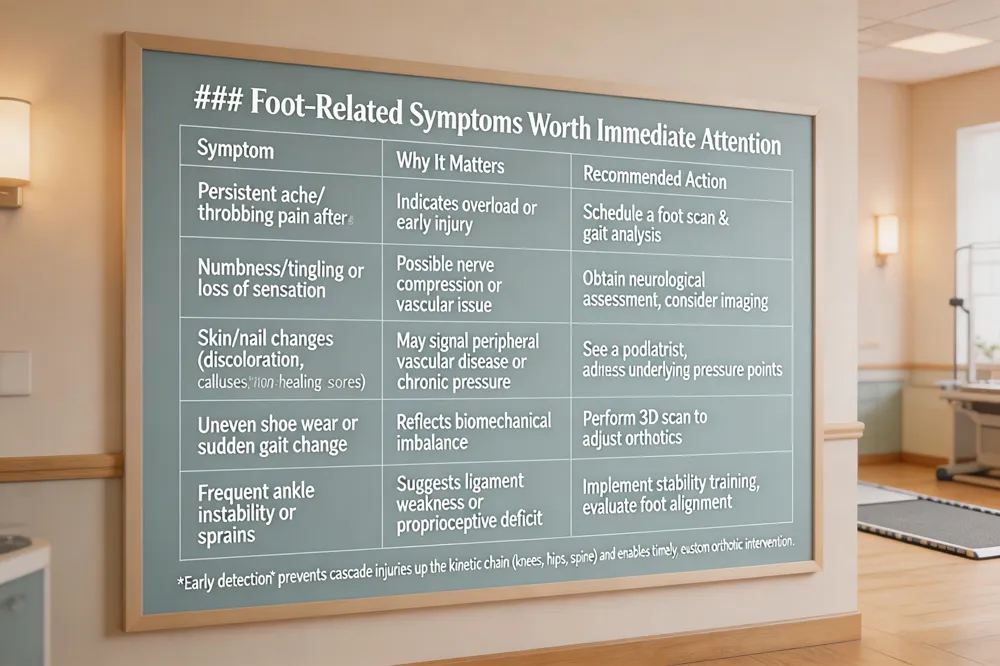
Foot‑Related Symptoms Worth Immediate Attention
| Symptom | Why It Matters | Recommended Action |
|---|---|---|
| Persistent ache/throbbing pain after activity | Indicates overload or early injury | Schedule a foot scan & gait analysis |
| Numbness/tingling or loss of sensation | Possible nerve compression or vascular issue | Obtain neurological assessment, consider imaging |
| Skin/nail changes (discoloration, thickening, calluses, non‑healing sores) | May signal peripheral vascular disease or chronic pressure | See a podiatrist, address underlying pressure points |
| Uneven shoe wear or sudden gait change | Reflects biomechanical imbalance | Perform 3D scan to adjust orthotics |
| Frequent ankle instability or sprains | Suggests ligament weakness or proprioceptive deficit | Implement stability training, evaluate foot alignment |
Early detection prevents cascade injuries up the kinetic chain (knees, hips, spine) and enables timely, custom orthotic intervention.
 Persistent ache or throbbing pain in the feet or ankles after normal activity should never be ignored. Numbness, tingling, or loss of sensation that comes and goes or stays constant is a warning sign. Visible changes in skin, nails, or hair on the feet—such as discoloration, thickening, calluses, or non‑healing sores—require attention. Uneven wear patterns on shoes or sudden changes in gait suggest misalignment that should be evaluated. Frequent ankle instability, repeated sprains, or a feeling that the ankle gives way are symptoms that must be addressed promptly.
Early detection of these signs matters because the foot is the foundation of the kinetic chain. Misaligned or painful feet can trigger compensatory patterns that strain the knees, hips, pelvis, and spine, leading to chronic back, neck, or shoulder pain. By identifying problems early, clinicians can use 3D foot scanning and gait analysis to create precise custom orthotics that restore neutral alignment, redistribute pressure, and prevent the cascade of biomechanical dysfunction. This proactive approach supports faster pain relief, improves overall posture, and reduces the risk of long‑term musculoskeletal injury.
Integrating Scanning, Gait Analysis, and Orthotics at Ross Chiropractic
Integrated Workflow at Ross Chiropractic
| Step | Tool / Technology | Key Benefit |
|---|---|---|
| 1. Foot scan | Handheld 3D scanner (0.1‑0.4 mm accuracy) | Rapid, non‑contact capture of neutral foot shape |
| 2. Gait analysis | Pressure‑mapping mat & motion capture | Objective data on dynamic loading and stride |
| 3. Data storage | Electronic Health Record (EHR) integration | Longitudinal tracking, easy retrieval |
| 4. Lab communication | Automatic email of STL files to partner lab | Faster turnaround, reduced material waste |
| 5. Orthotic fabrication | CAD/CAM laboratory processing | Precise, custom‑fit devices |
| 6. Patient education | 3‑D visual models & pressure maps | Improves understanding, adherence |
| 7. Follow‑up | Repeat scan & gait analysis | Adjust orthotics as biomechanics evolve |
Result: A data‑driven, drug‑free treatment plan that delivers quicker relief, ongoing monitoring, and sustained musculoskeletal health.
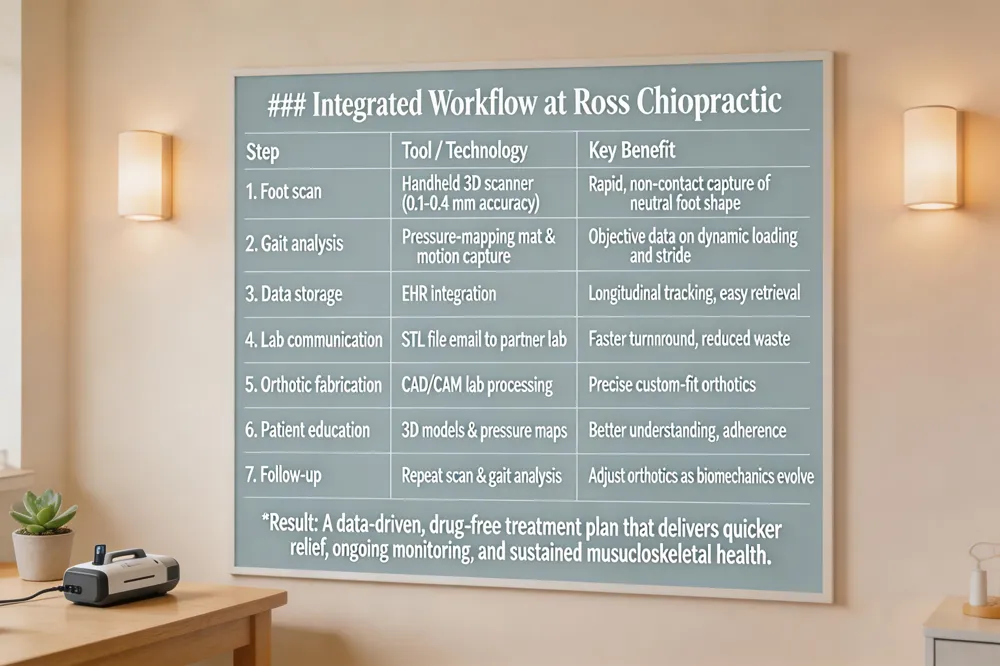 Ross Chiropractic’s drug‑free, holistic philosophy places the foot at the center of the kinetic chain, recognizing that misaligned arches can cascade into knee, hip, and spinal pain. By employing a handheld 3D foot scanner that captures a neutral, non‑weight‑bearing foot model within seconds, the clinic eliminates the mess and discomfort of plaster casts while delivering sub‑millimetre accuracy (0.4 mm to 0.1 mm). The digital scan is instantly uploaded to the clinic’s electronic health‑record system, where it is stored alongside gait‑analysis data from pressure‑mapping mats. This seamless workflow lets clinicians email the 3D model to partner orthotic laboratories across state lines, shortening turnaround time to a few days and reducing material waste. Because the scan and gait reports are archived electronically, Ross Chiropractic can track foot‑shape changes over months or years, adjusting orthotics as a patient’s biomechanics evolve. The visual 3‑D models and pressure‑map graphics also serve as powerful patient‑education tools, helping individuals see exactly how arch height, pronation, or leg‑length asymmetry affect their posture and pain. By integrating precise scanning, objective gait analysis, and custom‑fabricated orthotics into a single, drug‑free treatment plan, Ross Chiropractic delivers faster relief, long‑term monitoring, and a clear, data‑driven path to sustained musculoskeletal health.
Putting It All Together – A Path to Better Mobility
Digital foot scanning delivers a suite of tangible benefits that set the stage for truly personalized orthotic therapy. Scans are completed in seconds, capture the foot’s exact contours with sub‑millimetre accuracy (often within 0.1‑0.4 mm), and eliminate the mess, waste, and time required for plaster casts. The data is instantly emailed to the lab, enabling rapid design, CAD/CAM fabrication, and delivery of a custom insole within days rather than weeks. Because the model is stored electronically, clinicians can track changes over time and adjust the orthotic as the patient’s gait evolves.
When those precise digital models are translated into custom orthotics, patients experience a dramatic improvement in daily function. The insoles match every arch, heel, and forefoot contour, redistributing pressure, correcting over‑pronation or supination, and supporting the kinetic chain from foot to spine. This leads to reduced foot fatigue, fewer knee and hip complaints, and a noticeable boost in balance and comfort during walking, standing, or sport.
If you are looking for a drug‑free, evidence‑based solution that addresses the root biomechanical cause of your pain, schedule a 3D foot scan at Ross Chiropractic today. Our non‑invasive approach, combined with expert gait analysis, will deliver a custom orthotic designed specifically for your anatomy—helping you regain mobility, posture, and overall wellness.