Why Core Strength Matters for Chiropractic Care
Core stability is the foundation of spinal alignment. The deep abdominal muscles – especially the transversus abdominis, multifidus, pelvic floor and diaphragm – act like a natural corset, keeping the lumbar and thoracic spine in a neutral position during everyday movement. When these stabilizers are weak, compensatory patterns develop, increasing stress on intervertebral discs and facet joints and making the spine more vulnerable to injury.
Chiropractic adjustments restore joint mobility and reduce pain, but the benefits are maximized only when the nervous system can efficiently recruit the under‑active core muscles. Activation exercises (e.g., bird‑dog, dead‑bug, modified plank) retrain motor‑unit recruitment, allowing the spine to stay balanced after an adjustment and decreasing the likelihood of recurrent sub‑luxations.
Together, a strong core and a non‑invasive, holistic approach—combining adjustments, myofascial release, spinal decompression, EMScu® or and personalized corrective‑exercise programs—provide a comprehensive strategy that promotes long‑term musculoskeletal health without surgery or medication.
Core Exercise Recommendations from Chiropractors
Core Exercise Recommendations – Quick Reference
| Exercise | Primary Target Muscles | Key Benefits |
|---|---|---|
| Plank (forearm or modified on knees) | Transverse abdominis, rectus abdominis, serratus anterior | Improves overall core endurance while keeping spine neutral |
| Bird‑Dog | Multifidus, erector spinae, gluteus maximus | Enhances cross‑pattern stability & lumbar control |
| Glute Bridge | Gluteus maximus, hamstrings, lumbar multifidus | Activates posterior chain without lumbar flexion |
| Side‑Plank | Obliques, quadratus lumborum, multifidus | Lateral core strength and spinal alignment |
| Superman / Gentle lumbar rotation | Erector spinae, thoracic extensors | Promotes lumbar extension and thoracic mobility |
| Cat‑Cow (Mad cat) | Spinal flexors & extensors, thoracic mobility | Increases spinal fluid movement, reduces stiffness |
| Child’s Pose | Low‑back stretch, latissimus dorsi | Relaxes lumbar spine, improves flexibility |
| Pelvic Tilts | Transverse abdominis, lower back | Reinforces neutral lumbar posture |
| Half‑Kneeling Hip‑Flexor Stretch with Overhead Reach | Hip flexors, thoracic extensors | Improves hip & thoracic range, reduces anterior pelvic tilt |
| Chin Tilts / Chin Tucks | Deep neck flexors | Corrects cervical posture, reduces forward head strain |
| Shoulder Rolls | Upper trapezius, levator scapulae | Releases shoulder tension, promotes scapular mobility |
| Wall Angels | Serratus anterior, lower trapezius | Improves thoracic extension & scapular upward rotation |
| Seated Thoracic Twists | Rotational thoracic muscles | Enhances thoracic rotation, alleviates mid‑back tightness |
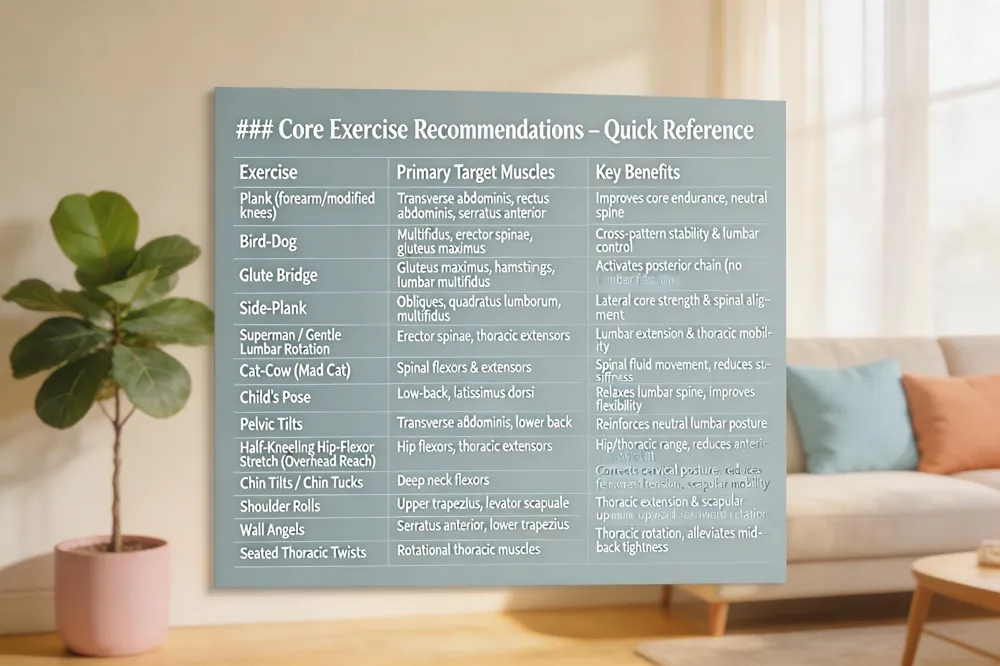 Chiropractors frequently prescribe low‑impact, core‑activating moves that protect the spine while building strength. The most common selections are planks (forearm or modified on knees), bird‑dogs, glute bridges, side‑planks, and gentle lumbar rotations such as the Superman. These exercises engage the transverse abdominis, multifidus, and erector spinae, providing the deep stability needed after an adjustment.
Stretching for spinal flexibility is paired with the core work. Cat‑Cow (Mad cat) mobilizations, Child’s Pose, pelvic tilts, and the Half‑Kneeling Hip‑Flexor Stretch with Overhead Reach improve range of motion in the lumbar and thoracic regions and relieve tension in the hips and lower back. Consistent deep supports the joint mobility that allows the core to activate efficiently.
Upper‑body mobility drills address common compensations that affect spinal alignment. Chin tilts, chin tucks, shoulder rolls, wall angels, and seated thoracic twists release tight chest and upper‑back muscles, promote proper head and shoulder positioning, and enhance overall posture.
Integration with chiropractic adjustments is essential. After an adjustment, patients perform the above core‑activating and stretching routines to reinforce neural pathways, maintain neutral spinal alignment, and accelerate recovery. When combined with personalized corrective‑exercise programs, these movements help reduce pain, improve functional performance, and support long‑term musculoskeletal health without surgery or medication.
Protecting the Lower Lumbar: L4‑L5 Considerations
L4‑L5 Guidance – Do & Don’t
| Category | Exercise / Activity | Reason / Modification |
|---|---|---|
| Avoid | Heavy overhead presses, bent‑over rows, deadlifts, squats, lunges | High compressive load & forward‑bending stress on L4‑L5 |
| Deep forward‑bend stretches (e.g., seated forward fold) | Increases lumbar flexion shear forces | |
| High‑impact cardio (running, jumping) | Repetitive axial loading can exacerbate disc irritation | |
| Rapid‑twist sports (tennis, volleyball, football) | Sudden torsional forces on compromised segment | |
| Safe Alternatives | Walking, swimming, elliptical training | Low‑impact, maintains cardiovascular health without lumbar overload |
| Modified Dead‑Bug (knees bent, arms to sides) | Neutral spine, engages deep core without shear | |
| Bird‑Dog (on hands/knees) | Promotes spinal stability with minimal load | |
| Glute Bridge (press hips up, keep spine neutral) | Strengthens posterior chain while protecting lumbar spine | |
| Side‑Plank (knees down or elbows) | Lateral core work with reduced lumbar stress | |
| Gentle hip‑hinge drills | Hip softional transmission, keeps lumbar neutral | |
| Neutral‑Spine Mechanics | Throughout all movements | Engage transverse abdominis (draw belly button toward spine) and exhale on effort to create intra‑abdominal pressure supporting vertebrae |
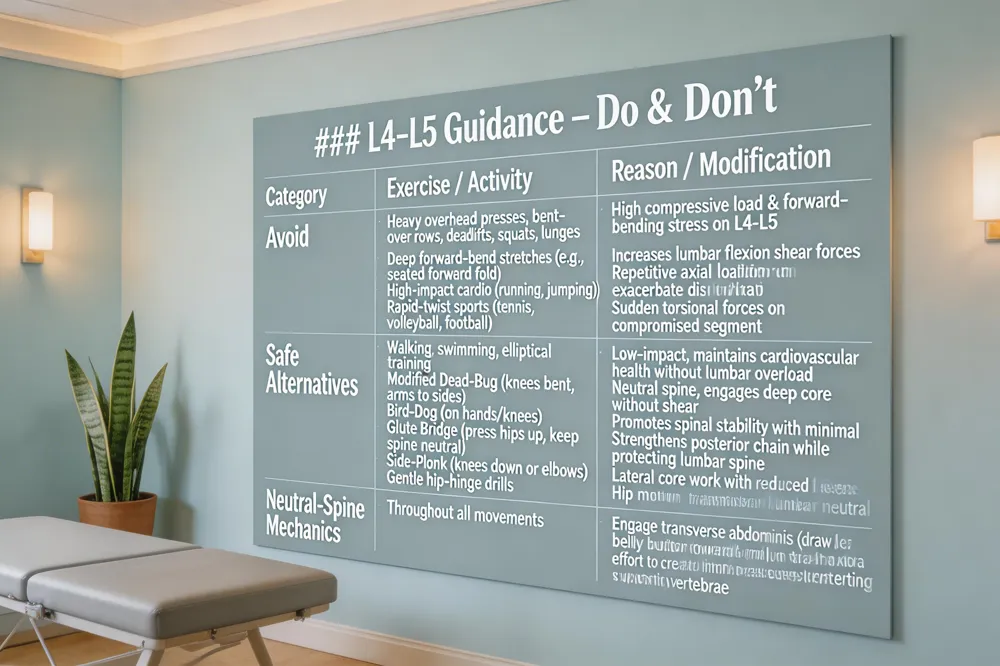
What exercises should L4‑L5 avoid?
When the L4‑L5 discs are compromised, avoid any movement that places excessive forward‑bending or compressive load on the lower lumbar spine. This includes heavy overhead presses, bent‑over rows, deadlifts, squats, lunges, and deep forward‑bend stretches. High‑impact activities such as running, jumping, or rapid‑twist sports (tennis, volleyball, football) should also be limited.
Safe low‑impact alternatives
Choose neutral‑spine motions that protect the segment while maintaining fitness: walking, swimming, elliptical training, and gentle hip‑hinge drills (e.g., modified dead‑bugs, bird‑dog, glute bridges). Core‑stability work on the forearms and knees or side‑planks with a reduced load also provides strength without stressing L4‑L5.
Neutral‑spine mechanics
Maintain a slight lumbar curve throughout each exercise. Engage the transverse abdominis by gently drawing the belly button toward the spine while breathing out on effort. This intra‑abdominal pressure supports the vertebrae, limits shear forces, and promotes proper alignment during all corrective‑exercise routines.
The Big 3 Core Stabilization Moves
McGill Big 3 – Summary Table
| Move | Execution Cue | Primary Muscles Engaged | Primary Defensive Goal |
|---|---|---|---|
| Curl‑up | Lie supine, one knee bent, hand behind head, lift head/shoulders while keeping lower back flat; exhale on lift | Transverse abdominis, rectus abdominis, obliques (isometric) | Provides controlled anterior core activation without lumbar flexion |
| Side‑Bridge (Side‑Plank) | Lie on side, elbow under shoulder, lift hips to form straight line; hold; progress to hand support | Obliques, quadratus lumborum, multifidus, gluteus medius | Stabilizes lateral spine, resists side‑bending forces |
| Bird‑Dog | On hands/knees, extend opposite arm & leg, keep pelvis level; engage core; repeat | Multifidus, erector spinae, gluteus maximus, transverse abdominis | Enhances cross‑pattern coordination & lumbar spinalension |
| Progression Tips | Increase hold time, add arm/leg extensions, use unstable surfaces | Improves endurance and functional stability |
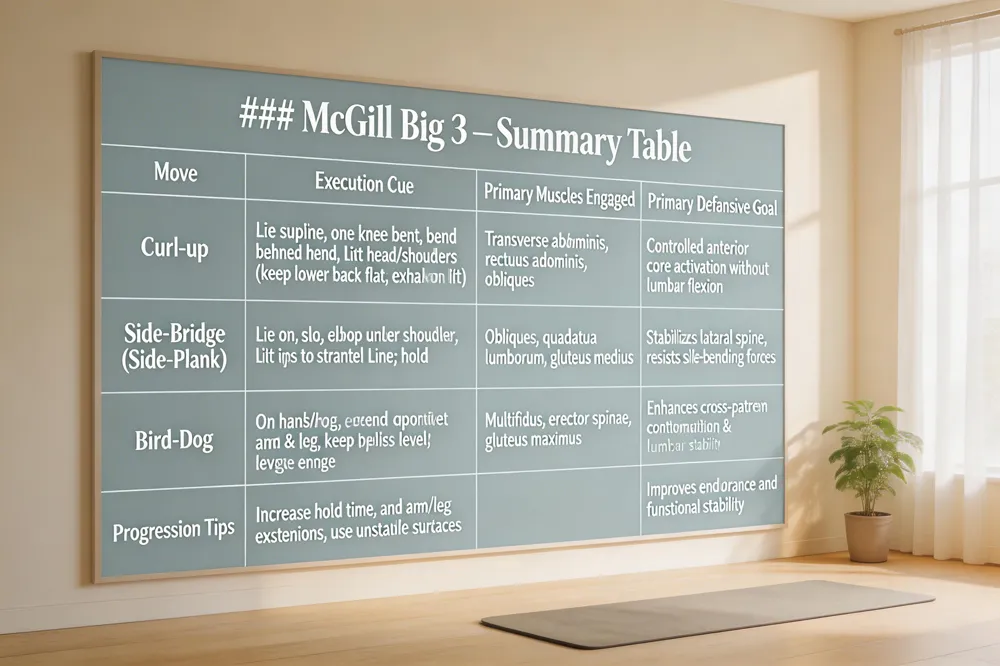 The McGill Big 3 is a concise, evidence‑based core‑stabilization routine composed of three low‑impact, spinal‑friendly movements: the curl‑up, side‑bridge (or side‑plank, and bird‑dog. Each exercise targets deep stabilizers while preserving a neutral lumbar spine. The curl‑up engages the transversus abdominis and rectus abdominis by lifting the head and shoulders with hips gently tucked, using controlled breathing to avoid lumbar flexion. The side‑bridge challenges the lateral core—obliques, quadratus lumborum, and multifidus—by holding a straight‑line position on an elbow or hand with hips raised, progressing to full‑hand support as strength improves. The bird‑dog coordinates contralateral activation of abdominal, gluteal, and spinal muscles; extending the opposite arm and leg while keeping the trunk stable reinforces cross‑pattern stability. Together, these three movements build a resilient, balanced core that protects the back, enhances posture, and supports daily functional activities.
Integrating the Corrective Exercise Continuum for Beginners
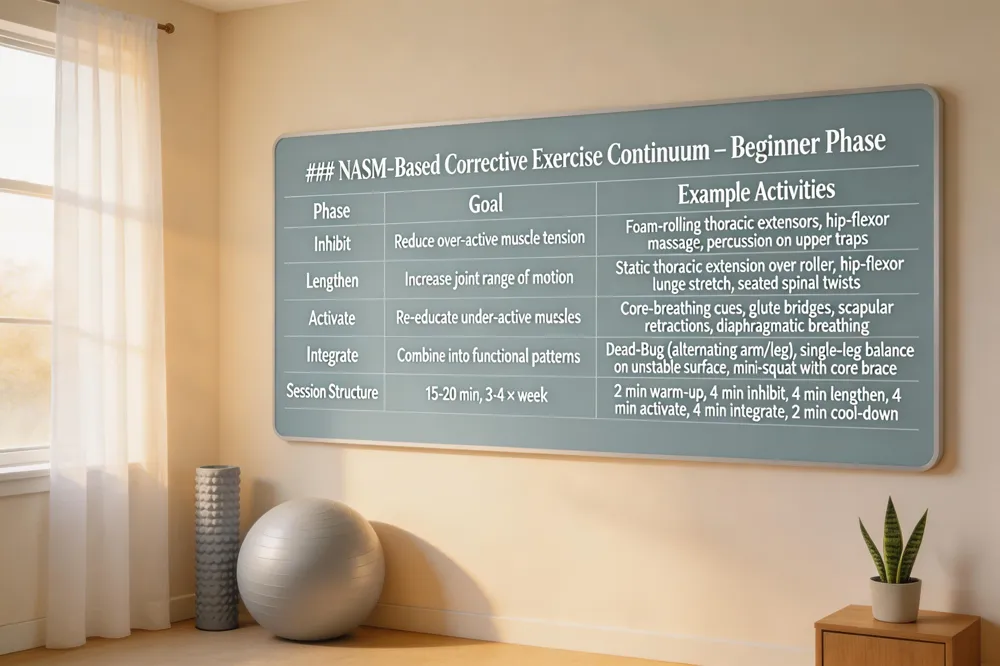
NASM‑Based Corrective Exercise Continuum – Beginner Phase
| Phase | Goal | Example Activities |
|---|---|---|
| Inhibit | Reduce over‑active muscle tension | Foam‑rolling thoracic extensors, hip‑flexor massage, percussion on upper traps |
| Lengthen | Increase joint range of motion | Static thoracic extension over roller, hip‑flexor lunge stretch, seated spinal twists |
| Activate | Re‑educate under‑active muscles | Core‑breathing cues, glute bridges, scapular retractions, diaphragmatic breathing |
| Integrate | Combine into functional patterns | Dead‑Bug (alternating arm/leg), single‑leg balance on unstable surface, mini‑squat with core brace |
| Session Structure | 15‑20 min, 3‑4 × week | 2 min warm‑up, 4 min inhibit, 4 min lengthen, 4 min activate, 4 min integrate, 2 min cool‑down |
 A chiropractor can be a pivotal partner in building core muscles strength. By performing spinal adjustments that improve alignment and mobility, the practitioner creates a stable foundation that lets deep core muscles—such as the transversus abdominis, multifidus, and pelvic floor—fire efficiently. Dr. Allison Ross, DC, also evaluates posture, identifies over‑active or under‑active muscles, and prescribes Corrective exercises (planks, bridges, bird‑dog while using myofascial release, cold‑laser therapy, or spinal decompression to reduce pain and inflammation, making core work more comfortable.
Corrective exercise routines for beginners follow the NASM Continuum: 1) Inhibit – foam‑rolling or percussion releases over‑active muscles (upper back, hip flexors). 2) Lengthen – static stretches (thoracic extension over a roller, hip‑flexor lunge) improve joint range. 3) Activate – core‑breathing cues, glute bridges, scapular retractions awaken under‑active muscles. 4) Integrate – functional patterns like dead‑bugs, single‑leg balance drills combine these gains into multi‑joint movements. The routine lasts 15‑20 minutes, 3‑4 times weekly, progressing without medication or surgery.
Common corrective exercises include partial sit‑ups, hip rolls, lumbar extensions, cat‑cow spinal mobilizations, superman lifts, double‑leg lifts, and rotational drills (seated spinal twists, external shoulder rotations). These low‑impact movements reinforce spinal stability, enhance posture, and complement chiropractic adjustments for faster recovery and injury prevention.
Core Training for Specific Needs
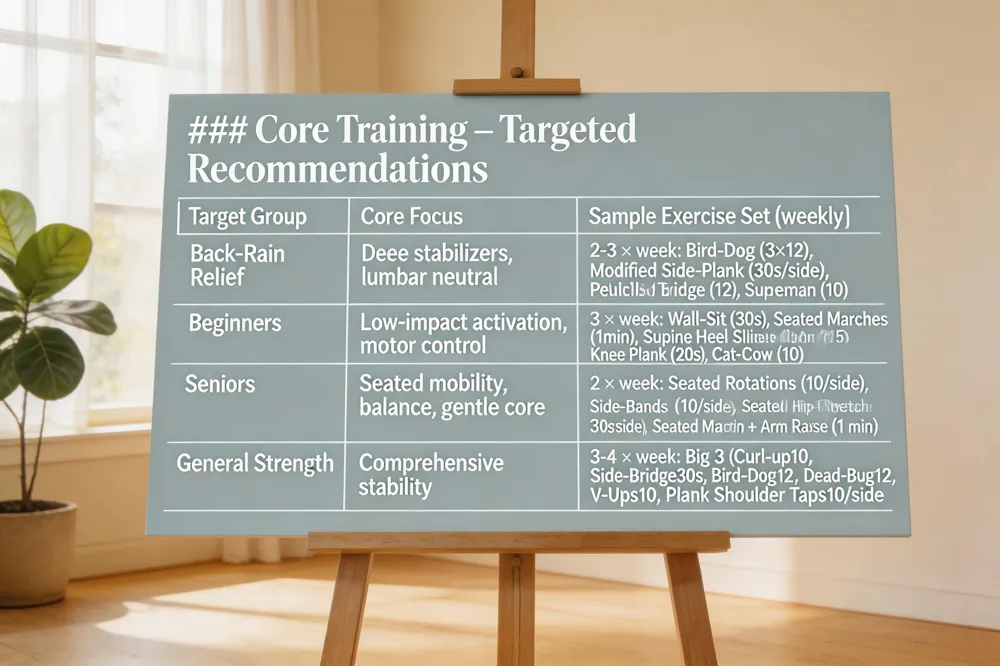
Core Training – Targeted Recommendations
| Target Group | Core Focus | Sample Exercise Set (weekly) |
|---|---|---|
| Back‑Pain Relief | Deep stabilizers, lumbar neutral | 2‑3 × week: Bird‑Dog (3 × 12), Modified Side‑Plank (30 s each side), Pelvic Tilts (15 reps), Glute Bridge (12 reps), Superman (10 reps) |
| Beginners | Low‑impact activation, motor control | 3 × week: Wall‑Sit (30 s), Seated Marches (1 min), Supine Heel Slides (15 reps), Basic Plank (knees, 20 s), Cat‑Cow (10 reps) |
| Seniors | Seated mobility, balance, gentle core | 2‑× week (min’s Pose10‑ Deep Pose releases: seated rotations (10 each side), side‑bends (10 each side), seated hip‑flexor stretch (30 s each), seated marching with arm raise (1 min) |
| General Strength | Comprehensive stability | 3‑4 × week: Big 3 (Curl‑up 10 reps, Side‑Bridge 30 s, Bird‑Dog 12 reps), Dead‑Bug 12 reps, V‑Ups 10 reps, Plank with shoulder taps 10 each side |
 A strong, well‑conditioned core can greatly lessen compressive forces on spinal discs by distributing loads evenly and keeping a neutral spine. This stabilisation reduces pressure on inter‑vertebral discs, helping prevent new compression‑related pain and supporting healing of mild disc irritation. However, core work alone cannot fully "fix" a significantly bulged or herniated disc; it should be combined with targeted therapies such as spinal decompression, myofascial release, and professional chiropractic guidance.
Core exercises for back pain – Gentle movements like dead‑bugs, bird‑dogs, modified side‑planks, pelvic tilts, bridges, and Superman extensions keep the spine neutral while strengthening deep stabilisers. Adding band pulls or side‑lying clamshells targets hip abductors and rotators that protect the back during daily tasks. Performing these 2‑3 times per week with proper breathing supports long‑term mobility and reduces reliance on invasive treatments.
Core strengthening for beginners – Low‑impact moves such as wall‑sits, seated marches, supine heel slides, and basic plank variations engage the deep abdominal and back muscles without strain. A simple 7‑minute circuit (cat‑cow, knee drops, cobra) warms the pelvis and lumbar region, while glute bridges and single‑leg abdominal presses target the transversus abdominis and obliques. Start with 30‑45 seconds per exercise, one set, and progress to three sets as tolerance improves.
Core stability fundamentals – Stability drills (bird‑dogs, dead‑bugs, side‑planks, planks with shoulder taps) focus on tightening the transversus abdominis and maintaining a neutral trunk. One set of 12‑15 controlled repetitions per exercise improves spinal alignment, reduces low‑back and neck pain, and enhances functional mobility, complementing chiropractic adjustments.
Senior‑focused PDF resources – A free 10‑minute seated routine PDF from Better5, recommended by Dr. Allison Ross, includes low‑breathing, gentle rotations, side bends, and twists designed to protect the spine and improve balance for older adults.
Best corrective action exercises – A balanced corrective program should include rowing motions, squat variations, windmill twists, prone rows, push‑ups, V‑ups, leg tucks with twists, supine bicycles, swimmer drills, and 8‑count push‑ups to address coordination, strength, and motor‑control deficits.
Putting It All Together: A Holistic Path to Spinal Wellness
Personalized corrective exercise sequencing begins with a brief assessment, then follows the NASM continuum—Inhibit, Lengthen, Activate, Integrate—tailored to each patient’s movement deficits. After a chiropractic adjustment, soft‑tissue work such as myofascial release or EMG‑guided techniques clears tissue restrictions, allowing the newly‑activated core muscles (transversus abdominis, multifidus, diaphragm) to engage safely. Patients receive a home program that blends bridges, bird‑dogs, and dead‑bugs with breathing cues, progressing from isolated activation to functional integration. Ongoing education reinforces proper posture, diaphragmatic breathing, and self‑monitoring, while regular check‑ins ensure the plan evolves with the patient’s recovery and supports long‑term spinal health for daily functional tasks.