Why Cyclists Turn to Chiropractic
Cycling demands a repetitive, forward‑leaning posture that loads the spine, hips and knees. Flexion of the lumbar region compresses intervertebral discs, while the pelvis tilts and hip flexors tighten, pulling the lower back out of neutral. Pedalling forces travel through the sacroiliac joints to the knees, where patellofemoral pain, IT‑band irritation or knee stress can develop. Riders often report lower‑back ache, neck stiffness, tight hamstrings, hip‑flexor tightness, and knee discomfort after long rides or training.
Chiropractic care addresses these issues without medication or surgery. Manual adjustments restore spinal alignment, relieving nerve irritation and allowing the core to stabilize the pelvis during the stroke. Soft‑tissue therapies such as myofascial release increase muscle flexibility, while corrective exercises strengthen weak stabilizers. Because the approach is natural, it supports the body’s own healing processes, reduces inflammation, and promotes faster recovery, enabling cyclists to train consistently and improve performance without the side effects of drugs.
Spinal Alignment and Core Stability
Spinal Alignment & Core Stability
| Key Points | Mechanism | Performance Impact |
|---|---|---|
| Neutral spine restores natural curvature | Chiropractic adjustment realigns vertebrae, releases thoracic/lumbar tension | Deep abdominal & back muscles engage efficiently → reduced energy drain |
| Improved neural communication | Alignment enhances motor‑unit recruitment | Smoother pedal strokes, higher power output |
| Reduced lower‑back discomfort | Tension release in lumbar region | Greater endurance on long rides |
| Consistent core stability | Continuous adjustments maintain alignment | Less fatigue, better posture on climbs |
 Cyclists spend hours in a forward‑leaning position, which can compromise the natural curvature of the spine and force the core to work harder to stay stable. Chiropractic adjustments restore a neutral spine by realigning vertebrae and releasing tension in the thoracic and lumbar regions. This alignment allows the deep abdominal and back muscles to engage efficiently, reducing the energy drain that leads to early fatigue on long rides. Research cited in multiple sports‑medicine articles shows that a properly aligned spine improves neural communication, enhancing motor unit recruitment and power output. Riders who receive regular spinal adjustments report smoother pedal strokes, less lower‑back discomfort, and a noticeable increase in endurance, confirming the link between spinal health, core stability, and cycling performance.
Joint Mobility and Pedal Efficiency
Joint Mobility & Pedal Efficiency
| Key Points | Mechanism | Performance Impact |
|---|---|---|
| Restored hip & SI joint mobility | Adjustments level pelvis, allow symmetric force transfer | Balanced power from both legs |
| Thoracic rotation regained | Facilitates relaxed aerodynamic posture | Maintains breathing & shoulder stability |
| Full 360° pedal rotation with less energy loss | Increased range of motion in hips/knees | Higher cadence efficiency, smoother strokes |
| Better climb performance | Equal push‑off force on pedals | Reduced fatigue on steep ascents |
 Chiropractic adjustments that restore hip and SI joint mobility allow the pelvis to stay level, which creates symmetric force transfer from each leg during the pedal stroke. When the thoracic spine regains its natural rotation, riders can maintain a relaxed, aerodynamic posture without compromising breathing or shoulder stability. Increased range of motion in these areas translates into a smoother, more efficient pedal cycle—muscles fire in the correct sequence, and the legs can complete a full 360° rotation with less energy loss. For climbers, a well‑aligned pelvis maximizes power output by ensuring both pedals receive equal push‑off force, reducing the fatigue that typically accompanies steep ascents. Regular chiropractic care, combined with targeted corrective exercises, keeps these joints supple and aligned, supporting consistent performance and faster recovery after long rides.
Soft‑Tissue Therapies for Flexibility and Recovery
Soft‑Tissue Therapies for Flexibility & Recovery
| Key Points | Mechanism | Performance Impact |
|---|---|---|
| Myofascial & active‑release techniques | Break adhesions, restore tissue glide | Improved joint articulation, less tension |
| Cold laser therapy | Low‑level photons reduce inflammation, boost metabolism | Faster tissue repair post‑ride |
| Restored lower‑body chain flexibility | Allows fuller aerodynamic position | Increased hip/knee mobility → higher power output |
| Accelerated soreness resolution | Enhanced cellular activity | Shorter recovery, more frequent training |
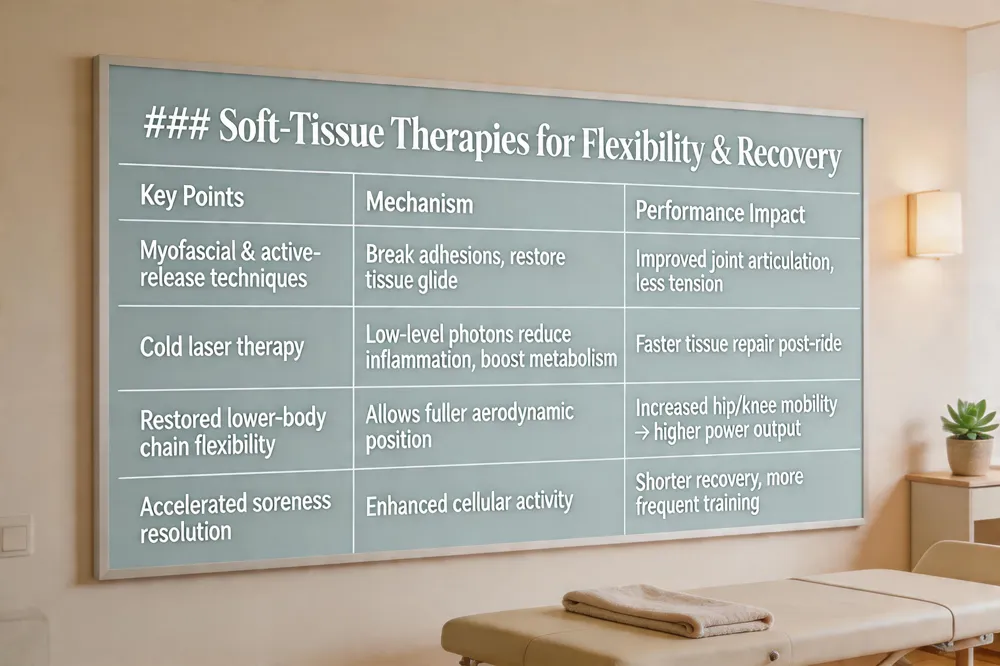 Myofascial release and active‑release techniques target the tight hip flexors, hamstrings and quadriceps that riders develop from prolonged forward‑leaning posture and repetitive pedaling. By breaking down adhesions and restoring normal tissue glide, these therapies relieve muscular tension, improve joint articulation, and re‑establish a balanced range of motion. Cold laser therapy complements soft‑tissue work by delivering low‑level photons that reduce localized inflammation, stimulate cellular metabolism, and accelerate tissue repair after intense rides or micro‑trauma. When flexibility in the lower‑body chain is restored, cyclists can achieve a fuller, more aerodynamic position without compromising comfort, allowing a smoother, longer pedal stroke. The resulting increase in hip and knee mobility translates directly into higher power output, while the faster resolution of muscle soreness shortens post‑ride recovery, enabling more frequent and higher‑quality training sessions.
Custom Orthotics and Bike Fit Optimization
Custom Orthotics & Bike Fit Optimization
| Key Points | Mechanism | Performance Impact |
|---|---|---|
| Foot realignment via orthotics | Stabilizes ankle, corrects pronation/supination | Neutral pedal stroke, efficient force distribution |
| Integrated bike‑fit adjustments (saddle, cleats) | Matches foot posture to bike geometry | Greater comfort, reduced overuse injuries |
| Improved knee & hip alignment | Prevents inward/outward knee drift, excessive hip rotation | Less joint pain, better power transfer |
| Long‑term consistency | Periodic orthotic & fit checks | Sustained performance, fewer interruptions |
 Foot biomechanics are the foundation of a cyclist’s kinetic chain. Misaligned feet can force the knees inward or outward, increase hip rotation, and create lumbar compression, leading to knee pain, hip discomfort, and lower‑back strain. Custom orthotics realign the foot, stabilizing the ankle and allowing a more neutral pedal stroke. By correcting pronation or supination, orthotics improve force distribution across the pedal, enhancing power transfer and reducing wasted energy. When orthotic assessment is combined with a professional bike‑fit, adjustments to saddle height, fore-aft position, and cleat alignment can be fine‑tuned to match the rider’s new foot posture. This integrated approach promotes long‑term comfort, prevents overuse injuries, and supports consistent training without chronic aches. Cyclists who use custom orthotics alongside regular bike‑fit evaluations report smoother rides, greater efficiency, and fewer interruptions from musculoskeletal pain.
Preventive Care and Long‑Term Performance Gains
Preventive Care & Long‑Term Performance Gains
| Key Points | Mechanism | Performance Impact |
|---|---|---|
| Routine chiropractic maintenance | Early detection of asymmetries, functional assessments | Prevents pain/injury before it develops |
| Personalized corrective‑exercise programs | Target core, hip abductors, glutes, rotators | Neutral pelvis/spine → efficient power transfer |
| Enhanced circulation & reduced inflammation | Regular adjustments improve tissue health | Faster recovery, fewer missed training days |
| Neuromuscular coordination improvements | Consistent care refines motor patterns | Sustained performance, long‑term musculoskeletal health |
 Routine chiropractic maintenance visits allow clinicians to identify subtle spinal or pelvic asymmetries before they develop into pain or injury, giving cyclists an early warning system for biomechanical drift. During these check‑ups, chiropractors conduct functional assessments, range‑of‑motion tests, and gait analyses that pinpoint muscle imbalances or joint restrictions. Based on the findings, personalized corrective‑exercise programs are prescribed, focusing on core stabilization, hip abductors, gluteus maximus, and deep rotator muscles. Strengthening these stabilizers promotes a neutral pelvis and spine, which translates to more efficient power transfer and reduced fatigue on long rides. A growing body of sports‑medicine research shows that athletes who incorporate regular chiropractic care experience significantly fewer missed training days and faster recovery times, likely due to improved circulation, reduced inflammation, and enhanced neuromuscular coordination. Consistent preventive care therefore supports both immediate performance and long‑term musculoskeletal health for cyclists.
Integrating Chiropractic into Your Training Plan
Start each season with a pre‑season screening to identify spinal, pelvic, and joint misalignments that could limit power output. Schedule mid‑season maintenance visits every 4–6 weeks to keep the spine neutral, relieve muscle tension, and prevent overuse injuries. Pair each adjustment with corrective exercises that strengthen the core, hips, and stabilizers, while a nutrition plan rich in anti‑inflammatory foods supports tissue repair. Stress‑management techniques such as mindfulness and adequate sleep enhance nervous‑system recovery. Dr. Allison Ross’s patient‑focused, non‑invasive approach—combining spinal adjustments, myofascial release, cold laser therapy, and custom orthotics—delivers natural performance gains without drugs or surgery.