Why Alignment Matters in Sports
Alignment‑based injury prevention refers to strategies that correct or maintain optimal spinal, joint, and foot positioning so forces are distributed evenly during sport. Proper joint and spinal alignment improves neuromuscular control, makes muscle activation more efficient, and reduces abnormal shear or compression on tissues, lowering sprain, strain, and overuse risk. Effective programs need collaboration among chiropractors, physical therapists, and coaches: chiropractors deliver adjustments and soft‑tissue work, therapists provide mobility and strengthening protocols, and coaches embed these principles into drills and equipment choices. Evidence includes Que du Soleil’s “Durability by Design” program (15 % injury reduction), a 2024 amateur‑athlete study linking good posture to fewer injuries, and clinical trials showing 30‑40 % lower lower‑limb injury rates with regular chiropractic care.
Understanding Posture and Alignment for Injury Prevention
Key Postures to Avoid & Alignment Benefits
| Posture to Avoid | Why It Increases Injury Risk | How Proper Alignment Helps |
|---|---|---|
| Prolonged rigid sitting/standing with weight shifted to one side | Compresses spinal discs & overloads joints | Distributes forces evenly across the musculoskeletal chain |
| Locked‑knee stance | Limits joint mobility, creates compensatory shear | Allows natural knee flexion, reducing shear stress |
| High‑heeled shoes | Forces ankle into plantar‑flexion, alters knee alignment | Promotes neutral foot position & proper kinetic chain alignment |
| Slouching / forward‑neck head‑craning | Increases cervical load, reduces thoracic mobility | Maintains natural cervical curvature, improves neuromuscular control |
| Rounded shoulders | Tightens pectorals, weakens upper back, leading to shoulder impingement | Aligns scapulae, enhances shoulder stability |
| Excessive wrist flexion | Increases load on carpal structures | Keeps wrist in neutral, reducing strain |
Practical Daily Habits (movement breaks every 30‑60 min, ergonomic setup, dynamic warm‑up, supportive footwear, core strengthening, hydration) support the alignment benefits listed above.
 Postures that increase injury risk include prolonged rigid sitting or standing with weight shifted to one side, locked‑knee stance, high‑heeled shoe wear, slouching, forward‑neck head‑craning, rounded shoulders, and excessive wrist flexion. These positions compress spinal discs, overload joints, and encourage compensatory patterns that lead to knee, hip, shoulder or lower‑back pain.
Proper alignment distributes mechanical forces evenly across the musculoskeletal chain. When the head, shoulders, spine, pelvis, knees and ankles maintain their natural relationships, load is shared rather than concentrated on a single structure, reducing shear and compression that cause strains, sprains, and stress fractures. Aligned movement also enhances neuromuscular control: the nervous system can fire stabilizing muscles in the correct sequence, improving proprioception and allowing automatic correction of minor deviations before they become injuries.
Practical daily habits to maintain alignment are: 1) take movement breaks every 30‑60 minutes; 2) use ergonomic chairs with lumbar support and keep screens at eye level; 3) perform a short dynamic warm‑up (leg swings, arm circles) before activity; 4) wear supportive footwear or custom orthotics; 5) engage in core‑strengthening exercises (bird‑dog, planks) and regular stretching; 6) stay hydrated to keep tissues supple.
What postures should we avoid to prevent injuries? Avoid rigid, asymmetrical sitting or standing, high‑heeled shoes, slouching, forward neck posture, rounded shoulders, locked knees, and excessive wrist flexion.
How does proper alignment contribute to injury prevention? It keeps the skeletal chain in natural relationships, spreads forces evenly, minimizes stress on individual joints and tissues, and promotes efficient muscle activation and neuromuscular control, creating a built‑in protective system against strains, sprains, and overuse injuries.
The Four‑Step Injury Prevention Model in Practice
Van Mechelen Four‑Step Model Simplified
| Step | Core Action | Typical Tools/Methods |
|---|---|---|
| 1️⃣ Establish Injury Extent & Data Collection | Capture incidence, severity, patterns | Athlete self‑reports, functional‑movement screens (FMS), biomechanical assessments |
| 2️⃣ Identify Mechanisms & Risk Factors | Pinpoint intrinsic & extrinsic contributors | Joint alignment analysis, mobility testing, Sense‑Think‑Act framework |
| 3️⃣ Introduce Preventive Measures | Implement targeted interventions | Tailored warm‑ups, sport‑specific strengthening, myofascial release, chiropractic adjustments, custom orthotics, ergonomic equipment |
| 4️⃣ Evaluate Outcomes & Adjust Programs | Monitor and refine | Ongoing injury rate tracking, performance metrics, athlete feedback, periodic re‑screenings |
Example Success: Cirque du Soleil’s “Durability by Design” program achieved a 15 % reduction in injuries using the model’s principles.
 The classic four‑step injury‑prevention model—originating from van Mechelen—provides a systematic roadmap for clinicians such as Dr. Allison Ross.
-
Establishing injury extent and data collection – Incidence, severity, and pattern data are gathered through athlete‑self‑reports, functional‑movement screens, and biomechanical assessments. This step highlights the prevalence of alignment‑related injuries (e.g., knee pain, low‑back strain) reported in recent amateur‑athlete studies.
-
Identifying mechanisms and risk factors – Analyses pinpoint intrinsic factors (poor joint alignment, limited mobility, asymmetries) and extrinsic contributors (improper footwear, inadequate warm‑up). The Sense‑Think‑Act framework further refines contextual causes, such as repetitive compensations from ankle stiffness that shift shear forces to the knee.
-
Introducing preventive measures – Targeted interventions are co‑developed with stakeholders: tailored warm‑ups, sport‑specific strengthening, myofascial release, chiropractic adjustments, custom orthotics, and ergonomic equipment. These align with the “prepare‑perform‑recover” pillars of Cirque du Soleil’s Durability by Design program, which achieved a 15 % injury reduction.
-
Evaluating outcomes and adjusting programs – Ongoing monitoring of injury rates, performance metrics, and athlete engagement informs iterative tweaks. Success is measured not only by fewer injuries but also by improved alignment, neuromuscular control, and a culture of proactive health stewardship.
General Rules and Practical Strategies for Athletes
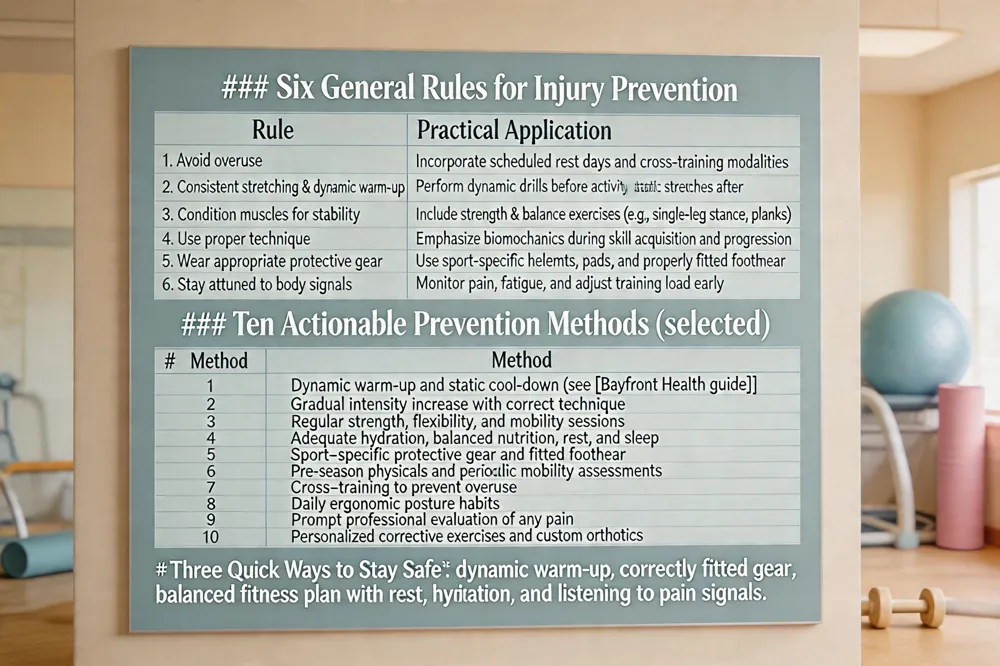 Injury prevention is essential for athletes to maintain health, performance, and longevity in sport. By minimizing sprains, strains, and overuse injuries, athletes preserve functional mobility, reduce medical costs, and avoid chronic issues that can end a career. A proactive, holistic approach—combining proper warm‑ups, balanced strength and flexibility programs, and appropriate equipment—supports long‑term wellness without reliance on surgery or medication.
Six General Rules for Injury Prevention
- Avoid overuse by incorporating rest and cross‑training.
- Perform consistent stretching and dynamic warm‑up before activity.
- Condition muscles for stability through strength and balance training.
- Use proper technique and mechanics in every movement.
- Wear appropriate, well‑fitted protective gear.
- Stay attuned to your body, heeding warning signs or pain early.
Ten Actionable Prevention Methods
- Dynamic warm‑up and static cool‑down.
- Correct technique with gradual intensity increases.
- Regular strength, flexibility, and mobility work.
- Hydration, balanced nutrition, adequate rest, and sleep.
- Sport‑specific protective gear and fitted footwear.
- Pre‑season physicals and periodic mobility assessments.
- Cross‑training to avoid overuse.
- Proper posture and ergonomic habits daily.
- Prompt professional evaluation of pain.
- Personalized programs with corrective exercises and custom orthotics.
Five Quick Ways to Stay Safe in Sport
Begin each session with a dynamic warm‑up, wear correctly fitted gear, follow a balanced fitness plan with regular rest, stay hydrated and nourished, and listen to pain signals, stopping when necessary.
Female‑Specific ACL Prevention Program
A structured program includes a dynamic warm‑up, neuromuscular drills (single‑leg balance, agility ladder, plyometric hops), hip and knee strengthening (band work, lunges, dead‑lifts), flexibility stretches, and core stabilization, performed 2–3 times weekly under professional guidance.
Comprehensive Sports Injury Prevention at Ross Chiropractic
Dr. Ross starts with a personalized movement assessment, then creates a conditioning plan that blends strength, flexibility, and cardio. Hands‑on therapies—myofascial release, spinal decompression, cold‑laser—enhance joint mobility. Warm‑up/cool‑down routines, hydration, equipment education, custom orthotics, and posture‑correction strategies address alignment issues, while ongoing monitoring ensures athletes stay injury‑free and perform at their peak.
Integrating Chiropractic Care and Alignment Interventions
Alignment‑Based Interventions & Their Benefits
| Intervention | Primary Benefit for Athletes |
|---|---|
| Chiropractic adjustments | Restores joint & spinal alignment → reduces abnormal loading & improves neuromuscular coordination |
| Myofascial release / trigger‑point therapy | Breaks up scar tissue → enhances fascia glide & circulation, decreasing muscle tension |
| Instrument‑assisted mobilization | Improves joint range of motion & reduces stiffness |
| Spinal decompression | Relieves disc pressure → promotes spinal health and pain reduction |
| Low‑level laser (cold laser) | Stimulates cellular repair → accelerates tissue healing without drugs |
| Custom orthotics | Aligns kinetic chain from foot upward → corrects pronation/supination, reduces downstream joint stress |
| Corrective exercise programs | Reinforces alignment gains → core stabilization, hip strengthening, neuromuscular retraining |
Evidence Snapshot: 2024 Ivy Rehab study & clinic data show athletes receiving regular alignment care experience fewer knee, ankle, and back injuries, faster return‑to‑play, and improved performance metrics.
 A multidisciplinary, alignment‑based strategy is emerging as a cornerstone of modern sports‑injury prevention.
Chiropractic adjustments restore joint and spinal alignment, reducing abnormal loading and enhancing neuromuscular coordination, which helps athletes maintain proper biomechanics during high‑speed movements.
Soft‑tissue therapies such as myofascial release, trigger‑point therapy, and instrument‑assisted mobilization break up scar tissue, improve fascia glide, and increase circulation, thereby decreasing muscle tension that can lead to strains and overuse injuries.
Complementary modalities—spinal decompression and low‑level laser (cold laser therapy)—further support tissue healing by relieving disc pressure and stimulating cellular repair without drugs or surgery.
Custom orthotics address foot‑pronation or supination, aligning the kinetic chain from the foot through the hip and lower back, while corrective exercise programs (core stabilization, hip‑strengthening, neuromuscular retraining) reinforce the alignment gains achieved through adjustments.
A growing body of evidence, including the 2024 Ivy Rehab study and clinical data from chiropractic clinics, shows that athletes who receive regular, non‑invasive alignment care experience significantly fewer knee, ankle, and back injuries, faster return‑to‑play times, and improved performance metrics.
Together, these interventions create a proactive, drug‑free preventive model that empowers athletes to take ownership of their musculoskeletal health.
Creating a Personalized Prevention Plan at Ross Chiropractic
Personalized Plan Components
| Component | What It Involves |
|---|---|
| Functional Movement Screening (FMS) & Postural Assessment | Identify asymmetries, limited mobility, neuromuscular deficits |
| Tailored Exercise & Mobility Program | Sport‑specific strengthening (hip, core, shoulder), flexibility drills, proprioception training |
| Ergonomic & Hydration Education | Proper workstation setup, fluid intake protocols pre‑/during‑/post‑activity |
| Recovery Strategies | Nutrition guidance, sleep hygiene, active cool‑down routines |
| Ongoing Monitoring & Re‑screening | Track progress, adjust interventions (add chiropractic adjustments, myofascial release, cold laser, orthotics) |
| Collaborative Coordination | Share results with coaches, trainers, and health professionals to align training loads and technique coaching |
Goal: Maintain optimal joint/spinal alignment, reduce injury risk, and enhance athletic performance through a evidence‑based, multidisciplinary approach.
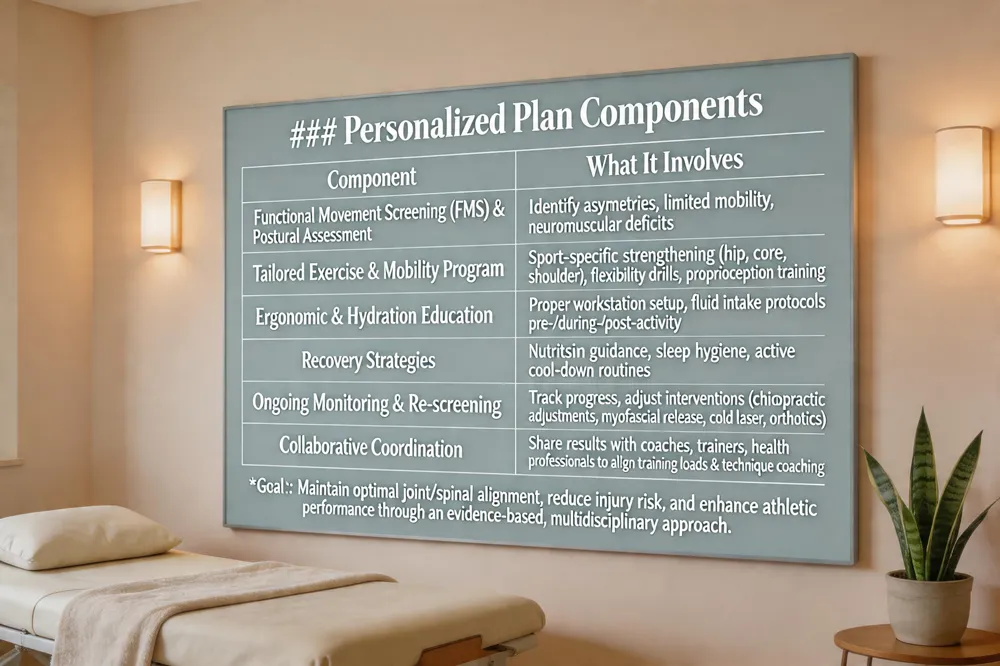 Ross Chiropractic builds a personalized injury‑prevention plan by first conducting a comprehensive functional movement screening (FMS) and postural assessment to identify asymmetries, limited joint mobility, and neuromuscular deficits. Using the data, a tailored exercise and mobility program is prescribed that blends sport‑specific strengthening (hip, core, shoulder stabilizers), flexibility drills, and neuromuscular retraining to correct alignment and improve proprioception. Athletes receive education on ergonomics, proper hydration protocols (pre‑, during‑, and post‑activity fluid intake), and recovery strategies such as nutrition, sleep hygiene, and active cool‑down, reinforcing the "prepare‑perform‑recover" pillars seen in successful programs like Cirque du Soleil's Durability by Design. Ross Chiropractic monitors progress with regular re‑screenings and adjusts interventions—adding chiropractic adjustments, myofascial release, cold laser therapy, or custom orthotics as needed—to maintain optimal joint and spinal alignment. Finally, the clinic collaborates with coaches, trainers, and other health professionals, sharing screening results and aligning training loads, equipment choices, and technique coaching to ensure a cohesive, evidence‑based approach that minimizes injury risk while enhancing performance.
Take the First Step Toward an Aligned, Injury‑Free Athletic Life
Alignment‑based injury prevention delivers measurable gains: improved biomechanics, fewer sprains and strains, faster recovery, and higher performance. By correcting joint and spinal positions, athletes reduce abnormal compressive forces, enhance neuromuscular control, and support optimal force transmission from core to extremities. Dr. Allison Ross’s movement assessment identifies hidden misalignments, creates a personalized plan, and integrates corrective exercises, myofascial release, custom orthotics, and spinal decompression. Schedule your evaluation today to unlock a safer, more efficient athletic routine. Meanwhile, adopt the daily habits outlined—dynamic warm‑ups, targeted strengthening, proper hydration, ergonomic ergonomics, and routine posture checks—to reinforce the alignment work and keep injuries at bay.